It’s not surprising that Michel Gondry once planned to be an inventor. More than any other contemporary filmmaker, Gondry’s cinema is one of imagination and ideas. From his groundbreaking music videos for Bjork and The White Stripes, to the Oscar-winning Eternal Sunshine of The Spotless Mind, the French-born director has trafficked in stretching the boundaries of image-making much the way a scientist seeks to redefine the physical world: for both it’s all about discovery through exploration. Cinematographer Ellen Kuras, ASC describes her on-going partnership with Gondry as a “continuum of ideas,” more than a series of camera assignments. She tells how the filmmaker showed up at her house one weekend with an assistant and several laptops, to hunker down and write Be Kind Rewind, his newest film. “I got one of the original scripts right off the printer,” Kuras laughs. “It was filled with Michel’s little drawings that he uses to communicate his ideas.”
Be Kind Rewind may be Gondry’s most alluring work yet. Jerry (Jack Black) and Mike (Mos Def) play two friends whose lives revolve around a video store in Passaic, New Jersey, named Be Kind Rewind, a stone-age throwback the digital juggernaut has yet to penetrate. When the owner of the store (Danny Glover) leaves town (he goes to Manhattan to spy on a Blockbuster-like chain to figure out how to bring in enough revenue to keep the property from being condemned), he puts Mike in charge. No sooner can you say Murphy’s Law than Jerry, a mildly deranged paranoiac who lives in a junkyard trailer, screws everything up. Literally. While attempting to sabotage a power plant, Jerry becomes magnetized and erases every single tape in the store! Glover sends his most loyal (and possibly only) customer (Mia Farrow) to check in on Mike while he’s gone. She tells them she’ll be back at the end of the day for Ghostbusters. Panicked, Jerry and Mike decide their only hope is to recreate the Bill Murray hit with themselves in the leads! And to their astonishment, the homemade VHS version gets great buzz around the neighborhood, with patrons lining up for more films, 2001: A Space Odyssey, RoboCop, Rush Hour, Boyz n the Hood, Driving Miss Daisy and The Lion King among them. The added revenue may even save the store from hungry condo developers. That is until the FBI comes crashing down for copyright infringement.
In creating a visual style for Be Kind Rewind, Gondry told Kuras he wanted to break with past efforts. The camera needed to be on cranes, sticks and dollies in a fixed position throughout, so Kuras recommended shooting in anamorphic. She also agreed with Gondry that VHS (rather than mini-DV) would work best for Jerry and Mike’s recreations, because of the media’s rounded analog feel. “The RCA VHS camera we see on-screen,” Kuras explains, “was a prop, because its iris could not be overridden electronically and the focus was automatic. We actually shot all the movie recreations with a Panasonic VHS camera that offered more control.” Kuras calls building the prop camera “very interesting.” Because Gondry wanted it to look like it was made from scraps, the DP went
with Dan Leigh, the production designer, to the junkyard, where they found a skateboard as the base and a hacksaw grip as a handle. “I put a quick-release on the bottom so we could switch out the VHS cameras, a monitor on the front for focus, and another monitor on the back for Michel to see the frame,” Kuras adds. “The ultimate effect on-screen has an emotional quality and I attribute that to the VHS.”
For an original documentary about Fats Waller that the store’s patrons all produce together to help save the shop, Gondry wanted to create an old scratchy movie quality to the VHS footage (the color was turned off on the VHS camera). With this goal in mind, the camera rig was then made even more complex by a fan Gondry placed in front of the lens that was rigged with another independent frame with wires hanging down and weighted by nuts and bolts, odds and ends found at the junkyard. These would emulate the shutter and the scratches on an old film print. However Kuras notes that whenever the fan blades passed in front of the lens, the camera would open its iris, seeking out information in the black areas, and solarize or “tear,” a problem that was ultimately resolved at EFILM in the digital intermediate.
Another reason Kuras wanted to shoot 2:40:1 was her fondness for the way the format’s depth of field tends to fall off toward the edges of the frame, a look she calls “painterly” and a perfect fit for the story’s fairy tale-like quality. The challenge was one of timing; so many productions were shooting anamorphic at the time that few if any lenses could be found. “I planned to use the Hawk lenses,” Kuras recounts, “because I had used them on various commercials and was comfortable with them. However, you need two weeks minimum to prep the lenses for an anamorphic show going to a theatrical release, and the Hawks did not arrive until a week before. The Hawks also proved a bit heavy, and had some issues during rack focus tests, so I put an emergency call into Panavision in New York to find two sets of anamorphic primes (Kuras shot with multiple cameras).” Kuras says Panavision New York and Woodland Hills “busted their butts” to find available sets of lenses but none were available. She notes that cinematographer Andrew Lesnie, who is a good friend of Kuras’, was shooting I Am Legend, and offered to loan out some of his lenses. Ultimately, Kuras opted to use JDC (converted Cooke lenses) paired with the ARRICAM ST cameras. She and first AC Carlos Guerra decided the Studio was quieter than the Lite, a key concern given that more than 75% of the movie takes place inside Be Kind Rewind, a single cinder block room that was converted from a Baptist church into the video store.
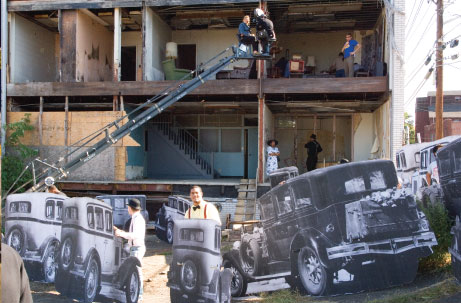
Practical locations were key to Gondry’s vision: every frame of Be Kind Rewind was shot in Passaic, New Jersey, presenting numerous challenges for gaffer John Nadeau. Kuras says she “begged” the production to consider an alternate location for the video store during the initial scout, because the street opposite the video store was in the sun the entire day. Couple that with a deeply shadowed interior, and a large range of skin tones for the cast, and Kuras says she was “dancing around” how many stops she was overblown outside. Inside the store, she knew she would need to carry focus of the anamorphic format at least three actors deep, so she augmented the existing overhead fluorescents with a grid of Kino Flo Image 80s and 4x4s, which were supplemented with several 18Ks pushing light in from a Condor outside the single picture window.
Kuras says lighting the location was tricky, but even that paled compared to craning multiple cameras above and around the store’s nearly wall-to-wall standing videotape racks. Gondry avoided using Steadicam inside the store, preferring a “jib-arm” type feeling to the camera movement. The solution was to embed a truss from one end of the store to the other that production designer Dan Leigh could disguise to look like part of the location. Kuras hoped to employ an upside down 15-foot Techno arm that would slide along the truss, in effect creating a telescoping jib-arm. “But that proved too costly for a five-week shoot,” she recalls. “We put a slider on the fixed-arm jib-arm we ended up using; but with no drag on the rails, if the camera hit the rubber stop on the slider, you would see the camera bounce in-frame. We also were limited with how far the arm could dip down without the ballast on the counterweight hitting a |