
by Matt Hurwitz / Photos by Macall Polay/ Framegrabs Courtesy of 20th Century Studios
In the last few weeks of December 1981, after completing the tour supporting his album The River, Bruce Springsteen settled down in a quiet rented home in rural Colts Neck, NJ, to write songs for what would be his Nebraska album. Wishing to stay clear of studios and engineers, he had his roadie/assistant, Mike Batlan, purchase a TEAC 144 four-track cassette recorder, with the resultant tracks ending up as the final product. The recordings were raw and real, reflecting the darkness of the rock star’s traumatic childhood he was recalling in that period of his life.
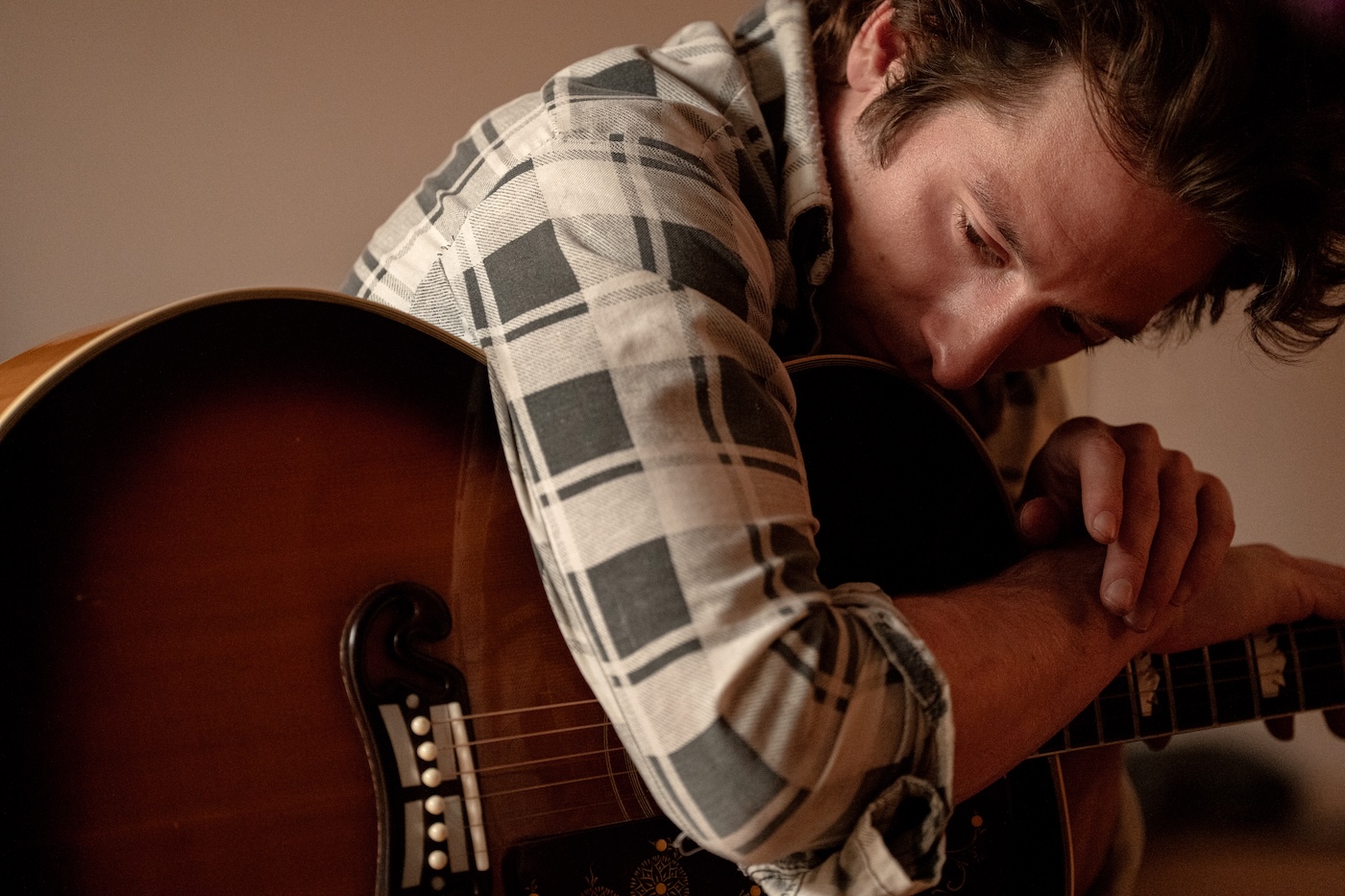
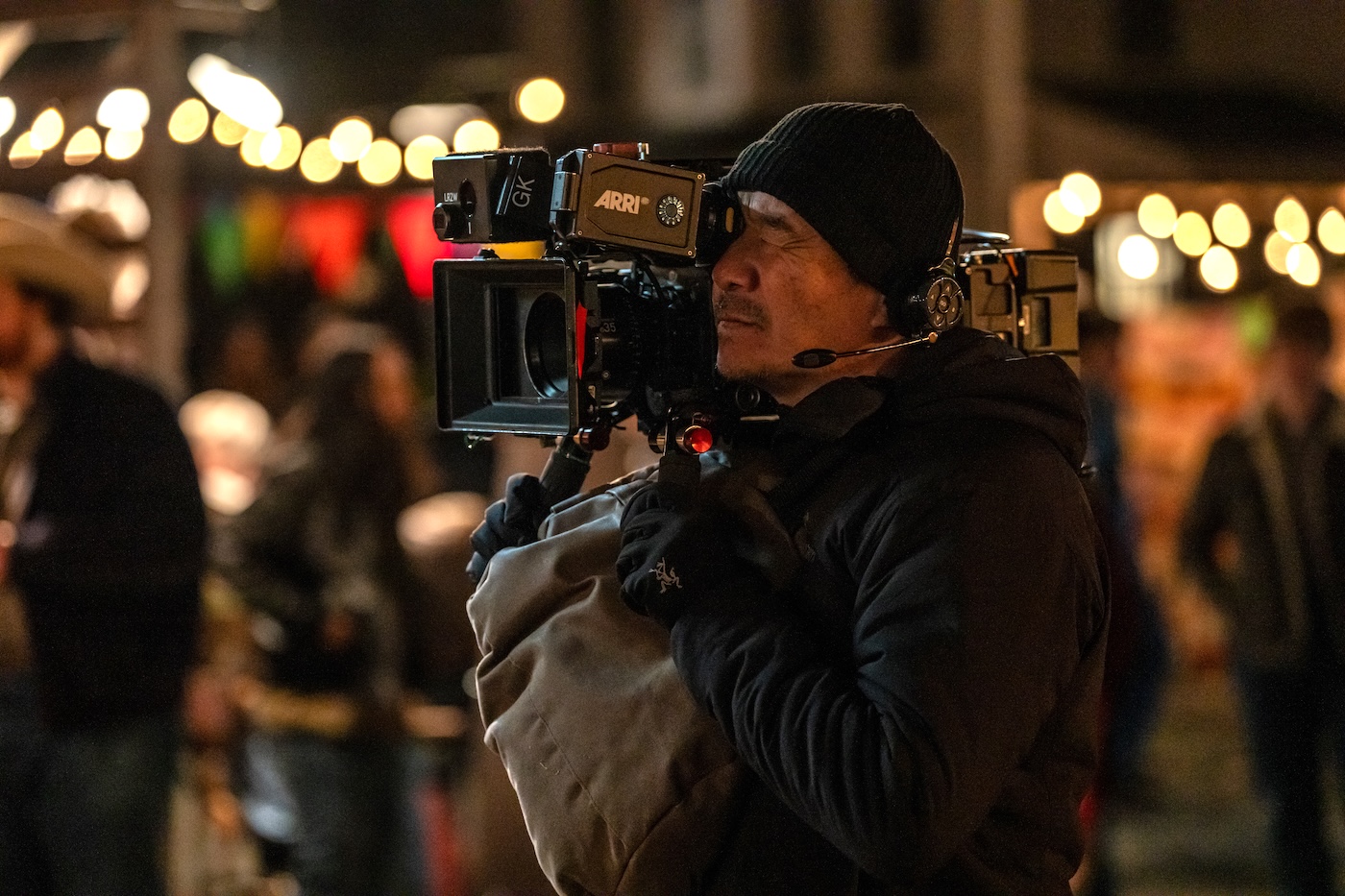
When Writer/Director Scott Cooper (Crazy Heart) began thinking of how to make a film out of Nebraska’s recording experience, he talked with his longtime collaborator, Director of Photography Masanobu Takayanagi, ASC, and the two had the same thought. “We said, ‘Let’s approach this story the way Bruce approached this music, as if we only had a four-track recorder,’” Takayanagi shares. “Let’s make a movie that feels like it was recorded in one bedroom, stripped down, raw and true.” Notes Cooper, “I said, ‘We’re not making a film about Bruce Springsteen, the icon. We’re making it about Bruce Springsteen [played by Jeremy Allen White], the man who’s dealing with unresolved trauma.’ It had to feel authentic, because Bruce is authentic.”
The result is 20th Century Fox’s new feature, Springsteen: Deliver Me from Nowhere, the fifth film Cooper and Takayanagi have made together, beginning with 2013’s Out of the Furnace and most recently The Pale Blue Eye in 2022. “I can’t say enough about Masa,” Cooper adds. “He is as trusted a collaborator as I have.” The two plan, envision, and shot-list to the point that, observes Takayanagi, “We’re like the same person. I know what Scott’s thinking, and he knows what I’m thinking.”
The pair brought along other frequent collaborators, including Production Designer Stefania Cella and A-Camera 1st AC Glenn Kaplan, who pulled focus for Takayanagi, also operating on Springsteen: Deliver Me from Nowhere. For a second camera angle, Takayanagi made use of longtime ICG Operator BJ McDonnell, fresh off shooting A-Camera on The Naked Gun. Though known for his invisible Steadicam skills, McDonnell was called upon for other frames on the Springsteen flick. As Takayanagi notes, “BJ is an amazing operator with a great sense of frame. You just have to give him an ‘Okay, BJ, let’s grab something,’ and he’ll do his thing. He got us so many great, creative images.”
While Local 52 Chief Lighting Technician John Alcantara had never worked with Cooper or Takayanagi, his work on last year’s Oscar-nominated biopic, A Complete Unknown, left a deep impression on both filmmakers. Alcantara brought along his whole team from A Complete Unknown, including Dimmer-Board Operator/Programmer Michael Hill, whose work played an important part in several key concert scenes for Springsteen: Deliver Me from Nowhere. Key Grip Mitch Lillian not only brought his many years on set, but also his son, Jack, who dolly-gripped the film. “He’s been working with me since he was 11,” the elder Lillian states. Notes McDonnell, “It was so much fun seeing father and son. And Jack is interested in Steadicam, so he was always asking me questions and learning.”
Research for the look of the film began in spring 2024 with a very important step. “Bruce loaded all of us into his Bronco – myself, Masa, Stefania, and Warren Zanes,” on whose book the film is based, Cooper recounts, “and took us down to Asbury Park.” The team had access to a wealth of resources, including Springsteen’s own notebooks and personal photo albums, and the musician’s archives at Monmouth University. “The first thing is to get educated about the places he comes from and how he grew up, and then make creative choices from there,” notes Cella. “With a living legend like Springsteen, there’s no room for missteps.”
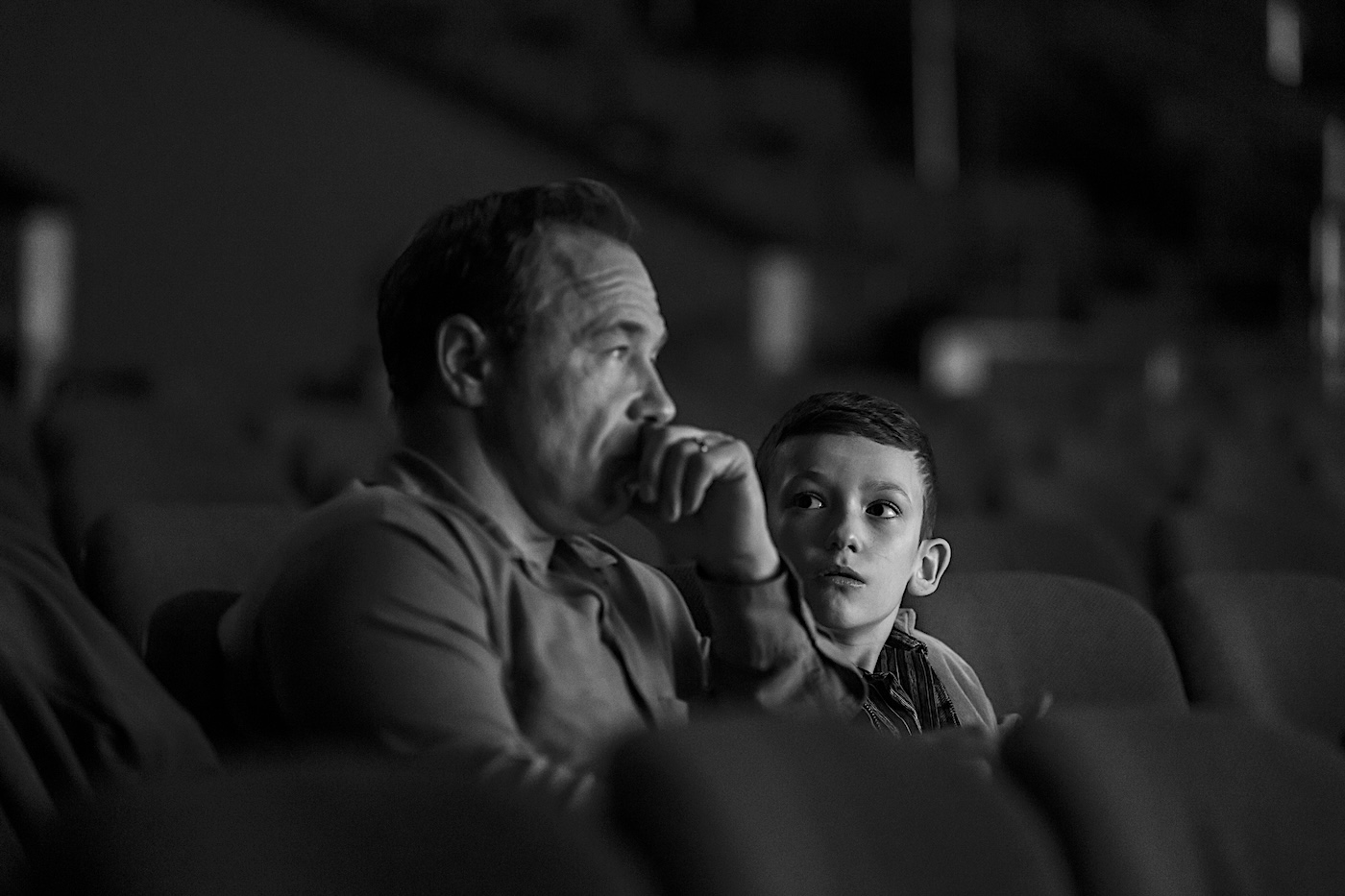
The film encompasses two key looks – the “present day” period of 1981-82 and flashback images of Springsteen’s childhood of 1958, each shot with different cameras and lens systems. “Bruce always said to me that he saw his childhood in black and white,” recalls Cooper. “He said, ‘I’m not sure if that’s because all the photography I saw was in black and white, but that’s how I remember it.’ And that’s why I chose to have all those scenes appear in black and white. It allowed us to capture a time in Bruce’s life when he was most vulnerable. He had a childlike innocence, but there was also emotional pain for a boy who was trying desperately to connect with his father,” (played by Stephen Graham).
Besides the childhood photos Springsteen provided, the team also referred to the black-and-white images of photographers Robert Frank and Saul Leiter, both of whose work, says Cella, “is contrasty, with not a lot of gray scale.” Adds Cooper, “Bruce has several copies of Robert Frank’s The Americans, and that became our North Star.”
For the flashback scenes, Takayanagi asked ARRI to create a black-and-white, monochromatic sensor for the ALEXA 35 Camera. “We knew we wanted to go with anamorphic for black and white, so we needed that Super 35 sensor,” he states. Notes Glenn Kaplan, “There were only two of them in the world – they were prototypes – and we were going to use that.” “It was amazing, but also brand new, out of the box,” Takayanagi recalls. “ARRI was super generous, but there were some inherent software glitches in the post [which they’ve since squared away], so it was a bit too risky for us.”
The decision was then made to shoot with an off-the-shelf ALEXA 35, with a specific black-and-white LUT, created by Company 3 colorist Tom Poole, who has refined the looks for 11 of Takayanagi’s films. The cinematographer was keen to give the scenes the look of a classic Kodak black-and-white stock for still cameras, Tri-X Pan, popular throughout the period, and for which he asked Poole to attempt to replicate. Takayanagi shot stills with his own Nikon manual focus camera with the Tri-X stock to give Poole a reference look while lens tests were being filmed, which were then processed and scanned, and put onscreen beside Poole’s images. “Tom tried to grade it, side by side. It’s not exactly the same, so he adjusted it to what we were looking for,” Takayanagi explains.
As Poole adds, “Masa made it clear how much he wanted an authentic photochemical look. And his reference still had a strong curve with softer shoulder and toe so as not to enter that harsh digital black-and-white space. We also refreshed the grain, settling on something that didn’t overpower the black and white image. Masa shot through these LUTs, so by the time it came to me, it was already in such great shape. Really just using small printer light adjustments to balance the flow of the narrative.”
After testing several anamorphic lenses, the team settled on 2.39:1 2× Atlas Orion anamorphics. “We were impressed with the fast T2.0 aperture, good close focus (between 18 inches and 3 to 6 inches ) and minimal distortion,” describes Kaplan. “The speed and T-stops are uniform, so when you light a scene, you can switch a lens and not have to readjust your light levels because one lens is faster than the other. They also don’t have a lot of aberration, which Scott and Masa liked.”
“Other lenses we considered had too much character – screaming to look at them,” Takayanagi adds. “The Orions could capture the moment honestly, and they offered a wide range of anamorphic focal lengths, especially in wide focal lengths. This was my first time using an 18-millimeter anamorphic,” notably a wide shot of young Bruce cowering on his bed, reading a Superman comic book, trying to tune out his parents’ fighting downstairs. “He feels really small in that space, with that wonderful lens.”
For the “contemporary” look, Cella avoided stereotypical 1980s colors, like purples and pinks. “For a movie taking place in 1981, we’d be seeing clothing, objects, and cars that are probably five or ten years old. So, we needed to recreate the seventies more than the eighties,” she explains. “Our master guidance was photographer Bruce Davidson,” whose book, Subway, captures scenes in New York with a very specific palette of muted colors, with Cella says, “pops of reds and yellows.”
For the 1981 scenes, Takayanagi used the ALEXA MINI LF, the full sensor being its biggest appeal, one which, he says, corresponds to still film, 36 × 24 mm. “I also like its shallow focus,” he states. For lenses, Cooper wanted something that not only would contrast with Springsteen’s past, as viewed with the anamorphics, but also, he says, “It’s about how can we dramatize Bruce’s anguish, his internal life – the introspection – how can we make the quiet get a little bit louder?”
To achieve that goal, Takayanagi opted for still camera lenses (spherical) rehoused for use in filmmaking. “It’s a completely different feel when you watch anamorphic films versus spherical,” explains Kaplan. “The information is different, the perspective that the lens sees differently, and it was fascinating to mix the two,” taking the viewer from what’s inside Springsteen’s mind, remembering, to his contemporary life.
ARRI’s Matt Kolze provided a list of available period lenses. Ten different sets were tested on ARRI’s stage before the team settled on a set of NIKKOR still camera lenses, rehoused by Whitepoint Optics in Finland. “It’s quite an engineering feat,” Kaplan notes. “Each donor lens has its own design, so it’s complex because of the optics and characteristics of each lens.”
Kaplan also had to keep an eye on the vintage lenses’ bokeh. “When you start stressing the lens, it gives you aberrations,” the AC explains. “It’s known in the stills world that when these NIKKOR lenses are wide open, they create a kind of glow on the outside of the frame. You can use it to your advantage, but for us, the blooming was unnecessary. So, instead of wide open, we always closed down a bit,” typically at f2.8.
Springsteen: Deliver Me From Nowhere was filmed on location in New Jersey and at Steiner Studios in Brooklyn. Interestingly, Springsteen was a constant presence, except for days when he had concerts – and, as Cooper notes, often on boyhood scene days with young Bruce and his father, which were a bit too painful to relive. “He was constantly on the phone with Scott; when he wasn’t there, it was ‘How did last night go?’ and then he’d be back on set that afternoon,” Kaplan recalls. “If I had a question about Bruce’s state of mind or, say, a room setup for the band, I could simply ask,” Cooper adds. “Those are things you can’t get from books, only from the subject himself.” And, notes Lillian, “There was never any criticism or rejection of what we were doing. He always offered encouragement to everyone.”
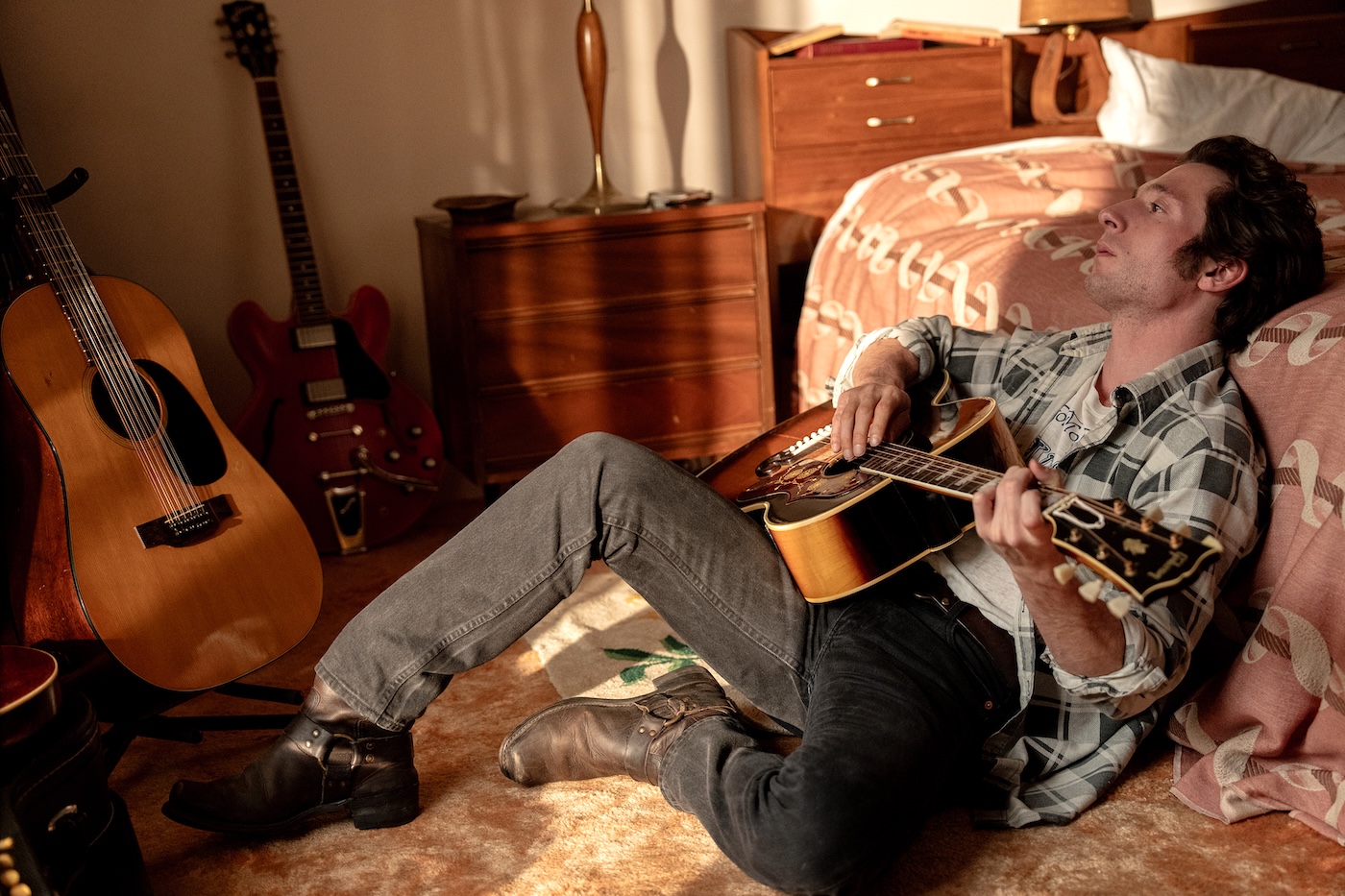
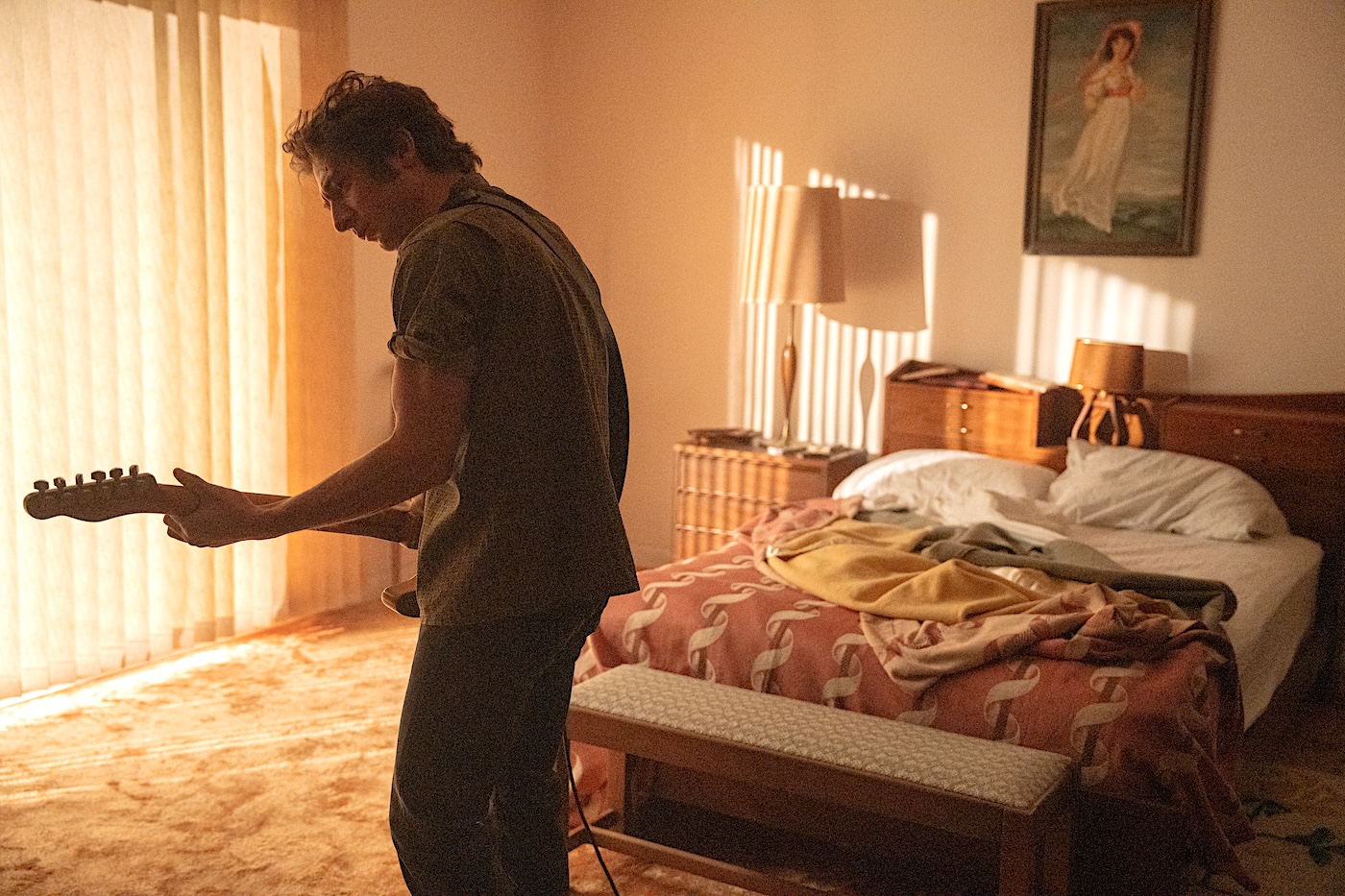
There are two major locations in the film – Springsteen’s childhood home in Freehold and the house in Colts Neck, NJ, where Nebraska was recorded. Springsteen brought the team to the iconic house, helping Production Designer Stefania Cella to create a period-accurate shooting set of the iconic bedroom at Steiner. “To have Bruce walk us through that space, show us where everything was – that’s the gift of having your subject not only be alive but also be so available and generous,” Cooper recounts. ” It’s the most remarkable filmmaking experience I’ve ever had.”
The home, while fascinating, was not viable for shooting. So, another house, located 90 minutes to the north, in Mountain Lakes, near the New York state border, was selected. Cella set up the living room (where Bruce repeatedly watches the 1973 film Badlands, the inspiration for his song “Nebraska”) and built a period kitchen into the existing dining room. As for the bedroom set, Cooper says, “It was easier for us to recreate it exactly to Bruce’s memory than to try and find it somewhere.”
Springsteen also loaned some personal items to the production. “The wallpaper seen in the bedroom set is a replica of that which appears in the background of his Darkness on the Edge of Town album cover,” Cella shares. “The painting hanging over the bed is from his home, and the lyric notebooks seen are a combination of the real thing from his archive and recreations.”
While the location house offered lovely views of the reservoir just beyond its forested backyard, the set did not. Instead of using a blue or green screen, or, worse, a curtained-off non-view, it was decided to employ a 30-foot-high, 47-foot-wide LED wall, projecting images captured by additional Camera Operator (and 2nd Unit B-Camera Operator) Matthew Pebler. “We did that for a couple of reasons,” Takayanagi explains. “One, a blue screen just doesn’t look good. And two, it helps Jeremy with his performance, projecting something in real time.” Notes Alcantara, “It’s far better than a blue or green screen, or just a lifeless Translight, to have trees, which have motion, and sunny days, where the water takes on a ripple. And Masa can play a deeper focus and actually see leaves dancing out there, and not just do it in post.”
Takayanagi went through the script, identifying times of day certain scenes take place, and assembled a list of plates for Pebler to gather. “We had one or two nights, post-twilight, a true night, and four or five day looks,” Alcantara recalls. DIT Mike Kellogg graded the images to match the look out the windows. “It also gave me the freedom not to be chasing the light, late afternoon, with the sun going down,” Takayanagi says. And the LED wall would often motivate the lighting in the room, its source informing the mood of the scene. Mitch Lillian provided a large 10-by-20-foot softbox within the 18 feet between the LED wall and the wall of the set, which was gimbaled, to augment what was coming from the LED. Alcantara says ARRI T12 Fresnels provided the late afternoon sun. Inside the room, the practicals did heavy lifting. Alcantara would swap in an Astera Nix bulb if it was desired to warm things up.
The all-important writing-and-recording scenes, with Bruce (and Mike Batlan) seated at a microphone with headphones on, playing his guitar and singing, were shot two-camera, with Takayanagi and McDonnell working in tandem. Both worked handheld, finding complementary angles to avoid White’s voice getting worn out from too much coverage. “It worked easily between us,” McDonnell recalls. “Masa might shoot on his left, and I’d be on his right, or vice versa. I might say, ‘What are you doing, Masa? Okay, you’re getting that? How about I come over with a tight lens, concentrate on his eyes, and go down to his fingers, to the strings?’ And Jeremy always had the mic in the same spot – you always want the microphone.”
The two had the advantage of an actor who not only was singing to the camera but also playing live as well – something White learned to do for the role. “It plays onscreen, because you can actually film his hands doing the string work on the guitar,” McDonnell notes. Adds Takayanagi, “It was really about capturing the performance and that moment in his journey.”
White was also shot using rear screen projection, constructed next to the bedroom set at Steiner. “We had a six-by-six-by-six-foot rear screen, projecting the fire scene from Badlands while Jeremy was performing ‘Nebraska,’” Takayanagi explains. Adds Alcantara, “We downscaled, so it felt claustrophobic, and did video playback using rear projection to create a truly surreal moment.” Though the shoot was extensive, only a few bits and pieces appear in the film, notably in the Texas State Fair sequence, when Springsteen’s panic and depression set in.
Step printing was also used in the sequence, shooting footage at 8 fps, which, at the printing stage, is played back at that same speed (instead of 24 fps). “It tends to introduce a dreamy feel,” Kaplan explains. The MINI LF also allows its shutter to be set almost open, to 356 degrees, “so when you capture the moment,” adds Takayanagi, “each frame has a little blur, perfect for what we were trying to illustrate.”
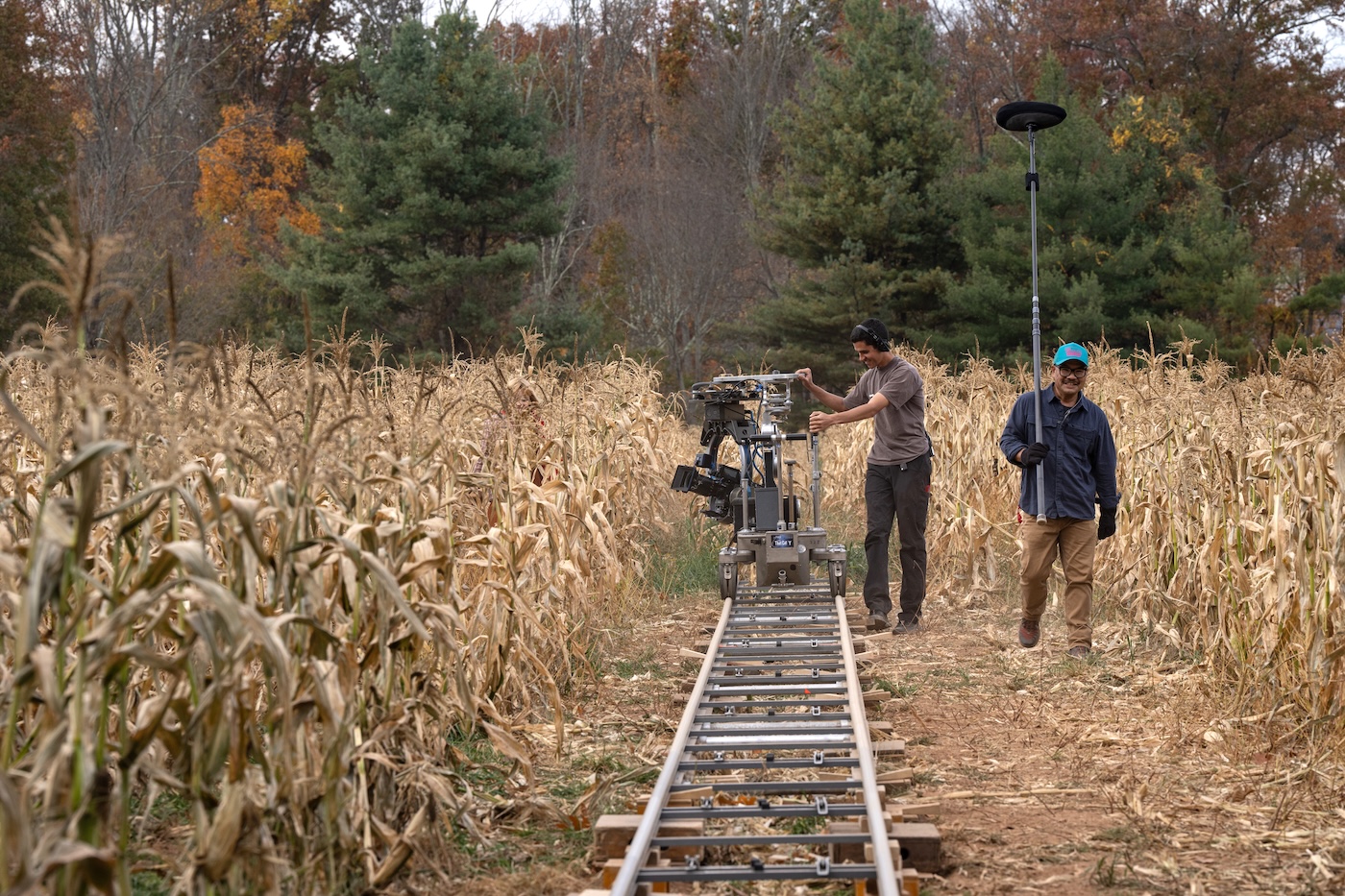
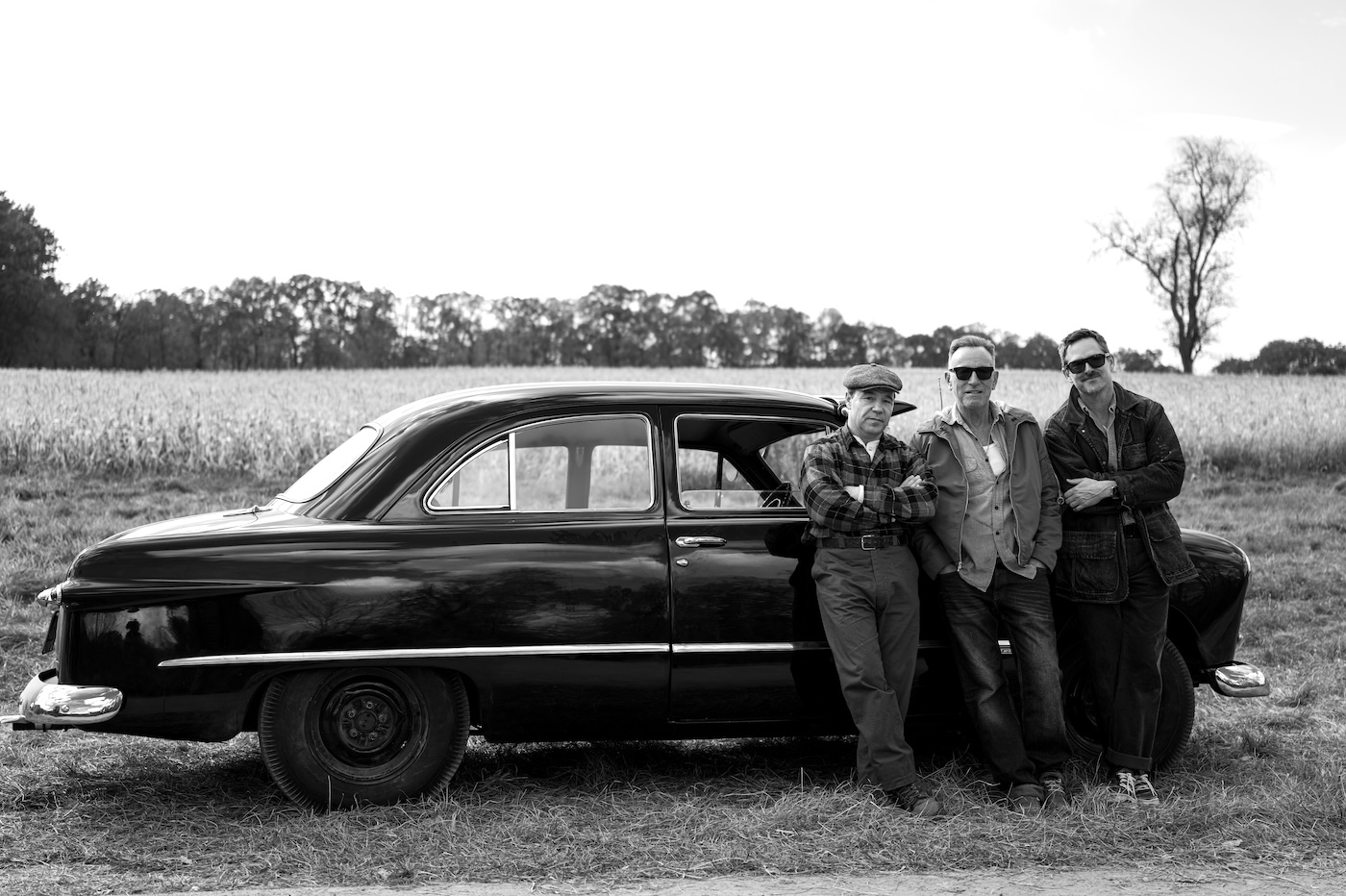
One of the most striking black-and-white scenes is when Bruce’s father drives him and his sister, Virginia, into the countryside. He stops at a beautiful farmhouse and turns the kids loose to run through a wheat field. The experience was the inspiration for Springsteen’s Nebraska song “Mansion on the Hill” and was shot as a combination of three shots, beginning with one utilizing a fixed-arm Giraffe crane. The car arrives, there’s some dialogue at car level, and the camera rises to reveal the house as the children begin to dash out into the field. They are followed by a drone, as well as a dolly, capturing their joy in a three-quarter profile.
The latter was captured by McDonnell on the first day of filming, with Jack Lillian speeding the operator along on the track. The drone, used here and elsewhere by 2nd Unit, was a DJI Inspire 3, provided and operated by Flying Monster Cinema Drones. It supported DJI’s Zenmuse X9 8K Air Camera. “It was one of the few times we feel the movement and freedom that’s not in the rest of the 1950s scenes, which have a restricted language,” explains Takayanagi. Adds Cooper, “Even though his father is on the outskirts of the field, Bruce is running with his sister, playing, as kids do when they’re at their freest and most innocent. I wanted to capture that, to show a child who wasn’t simply hiding in fear from his father.”
Additional drone work, shot by 2nd unit Director of Photography Chris Bottoms, also played a key role. Takayanagi asked Bottoms to capture images depicting Bruce and his best friend, Matt Delia, driving across the country to Los Angeles. The scenes were shot mostly in High Point State Park in Northern New Jersey, but also on the Delaware Memorial Bridge, which was closed for the production for half a day.
“Masa was specific about how he wanted that drone shot,” Bottoms states. “Ninety degrees, facing down, perpendicular to the world. He wanted me to treat the drone like a dolly shot and not like a car commercial. He didn’t want it to look slick.” Adds Takayanagi, “It’s all about Bruce trying to run away from reality. And by looking straight down, we contrast the beautiful nature around him with Bruce in this tiny car, just a great sense of his loneliness.” Bottoms shot with DJI’s Zenmuse X9 camera, cropped to 2.40:1, providing a RAW file in log format.
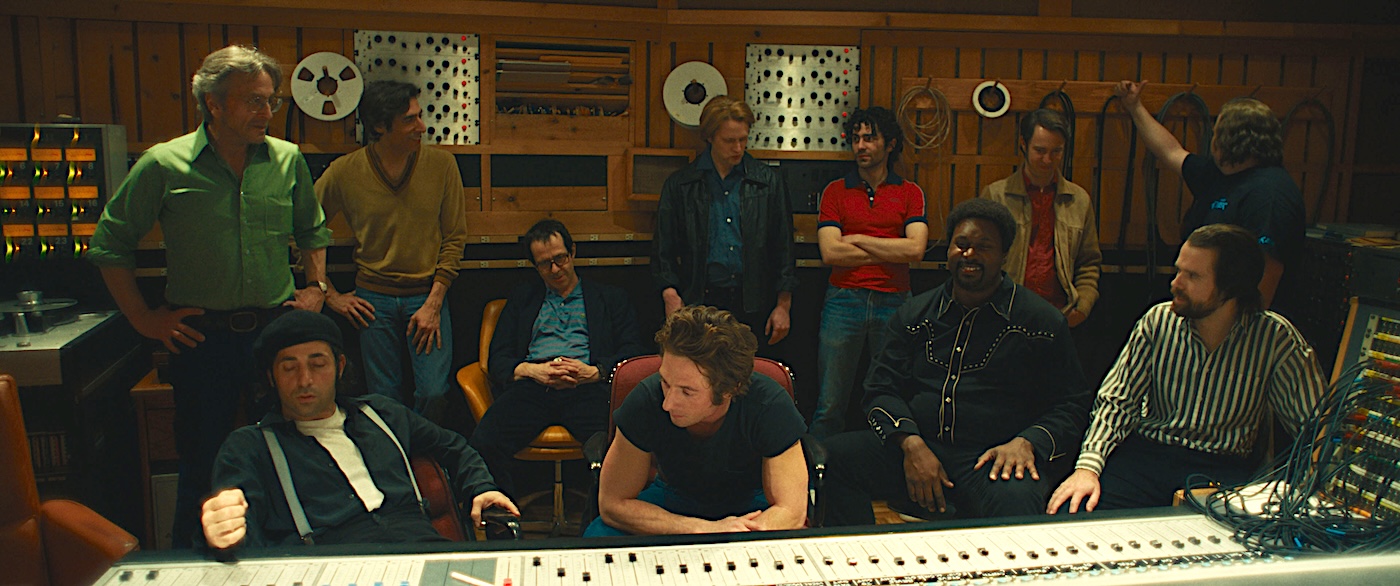
The team also spent three days in the historic Power Station, on West 53rd Street, where countless hit records have been recorded. An important scene showing the recording of “Born in the U.S.A.” with Bruce and his E Street Band buddies was shot in Studio A – the same room in which the song was recorded. The band layout and setup were provided by Springsteen and his longtime producer, Jon Landau, both of whom were present for the day’s shoot.
The scene was shot with two cameras, with both Takayanagi and McDonnell operating handheld. A Ronin was also used, mounted on a Steadicam arm and operated by Pebler. “We wanted to inject some energy and movement,” Takayanagi explains, “and you would have felt the handheld too much.” Notes McDonnell, “With Steadicam, you’re limited to your highs and lows, but with the Ronin, you can float in and around people. You can go up to their faces, down to their feet, and keep it all seamless.”
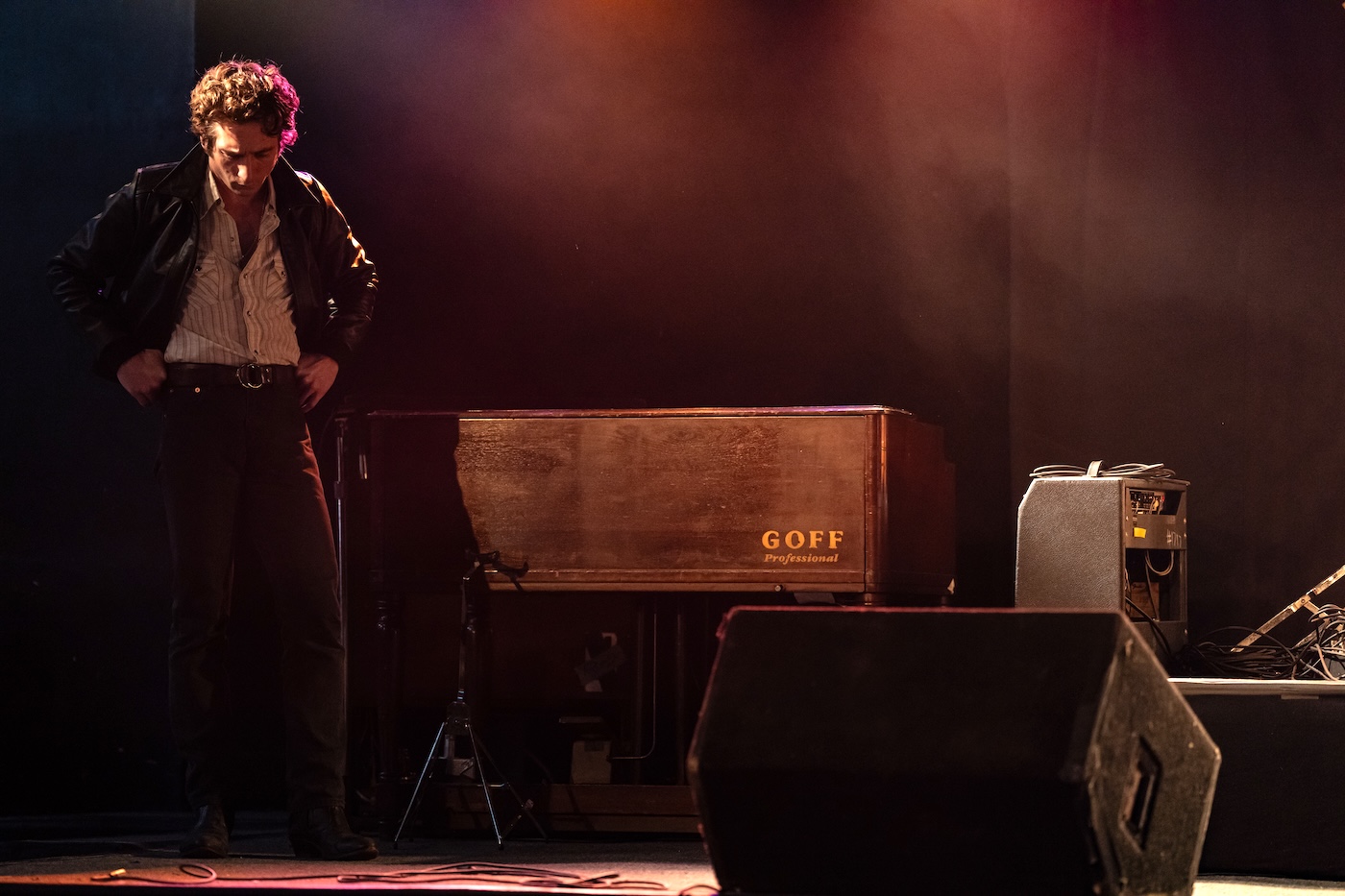
The team also shot a few performances at the iconic The Stone Pony, in Asbury Park, with White playing with the musicians portraying the band, Cats on a Smooth Surface, and Cella’s art team restoring the front marquee to its 1981 state. “The Art Department put up traditional gooseneck scoop hat lights, and we wired those with tungsten flood bulbs to create shapes on the walls,” Alcantara recalls. “We hung a few and didn’t turn them on, to look like there were burnt-out bulbs, and then set them up crooked, so it didn’t look like a movie crew came in and made everything look nice.”
With hundreds of extras adding to the shoot’s energy, Alcantara says, “People would come in and out of shadows – and that was intentional. This was essentially a dive bar, and we wanted Jeremy to travel in and out of people’s spots, not follow him, as would be at Madison Square Garden.” Hill programmed a series of lighting cues for each song over two days, which, after review by Takayanagi, were put to work on their representative songs.
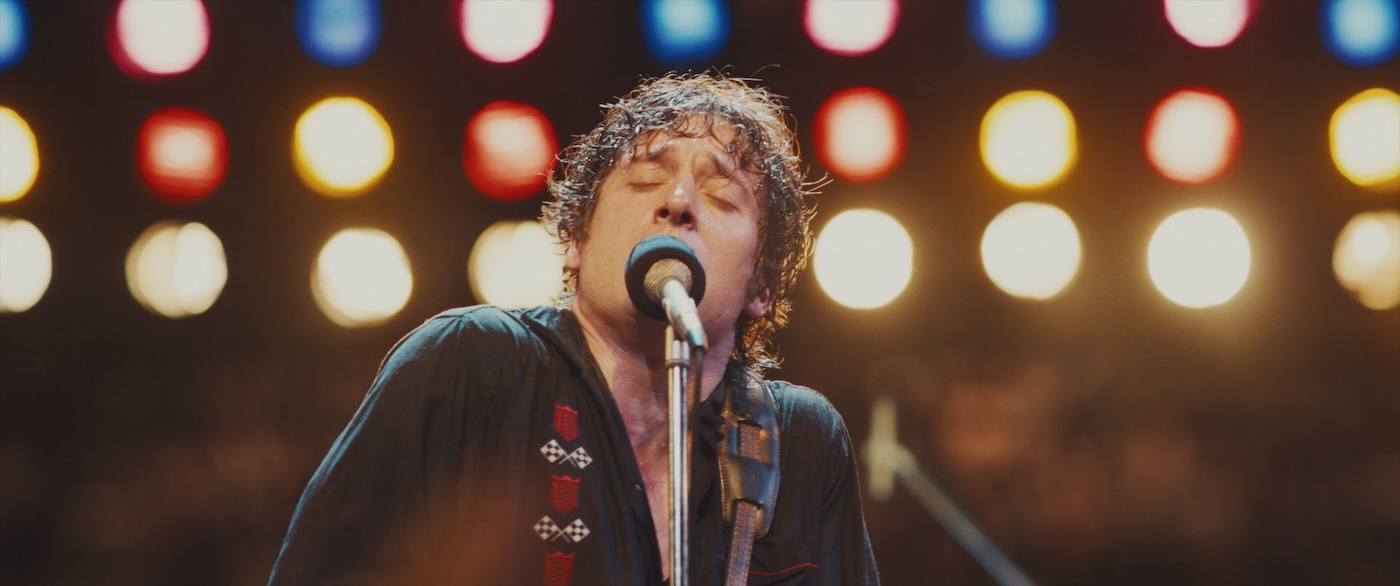
In early January 2025, a huge concert scene, including a raucous version of “Born To Run,” was filmed at the (closed) Izod Center in New Jersey. Springsteen’s E Street Band was set up on a 40-by-28-foot stage, built by Cella, with a 100-by-20-foot blue screen 40 feet from the front of the stage, to enable VFX to extend the crowd of 500 background players. Alcantara studied YouTube footage of the original River tour stage and selected a PAR can-based lighting setup, which he carefully designed using Vectorworks, allowing Hill to preload his color designs. “We delivered a previs of the whole arena, with each person onstage at different positions, which we showed to Masa and Stefania, and they both loved it,” Alcantara recalls.
Sadly, that same period also coincided with the devastating Palisades fire in Los Angeles. McDonnell had already gone home the day before after urgent pleas from his family. Cooper recalls looking over McDonnell’s shoulder, who says that “I had my phone, and tapped on my security camera in my house, and when the image came up, everything was on fire. Scott said, ‘Oh, my God, is that your house?’” Needless to say, McDonnell flew out the next morning (though there was nothing left to save). On the 8th, shoot day, it was Cooper’s turn to get frantic calls about his house, also in the Palisades. “We knew the fire was coming, but we never expected it to consume our house,” the director recalls. “When it approached, my wife evacuated our daughters, Ava and Stella, and our dogs and moved to a hotel. Then my neighbor called to say, ‘Your house is burning. And there’s no saving it.’” Says Takayanagi, “Scott talked with his family, and they just said there was nothing we could do if we came back, so please finish the film and come back at the end of the shoot, a few days later.”
And so, despite the tragedy, the filmmakers soldiered on, capturing the ending scene between Springsteen and his father backstage. “The crew was incredibly supportive,” Cooper states. “Everyone knew my and BJ’s house had burned, and their love and support were something we’ll never forget.” They weren’t the only ones offering support. As Cooper concludes, “Bruce said to me, ‘Scott, get the girls out of the hotel, and move them into my house.’ Our daughters lost everything, including my daughter Stella’s guitar. So what does Bruce do? He sends her one of his.”
Local 600 Crew List: Springsteen: Deliver Me from Nowhere
Director of Photography: Masanobu Takayanagi, ASC
A-Camera Operator: BJ McDonnell
A-Camera 1st AC: Glenn Kaplan
A-Camera 2nd AC: Adam Russell
B-Camera 1st AC: Anthony DeFrancesco
B-Camera 2nd AC: Carrie Wills
DIT: Mike Kellogg
Loader: Zakarias Aidt
Loader/Utility: Emily Khan
Unit Still Photographer: Macall Polay
Stunt Unit