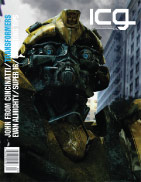
TRANSFORMERS, DP Mitchell Amundsen
By Pauline Rogers EVAN ALMIGHTY, DP Ian Baker
By Elina Shatkin JOHN FROM CINCINNATI, DP Joe Gallagher
By David Heuring PRESIDENT'S LETTER
by Steven Poster, ASC
SUPER 16 UPDATE, By Bob Fisher NEW GENERATION, DP Jo Willems
By Robert Allen OPERATING TIPS
By Bill Hines and Dan Kneece, SOC PARTNERS ON THE SET, Chatham DP Phil Schwartz and operator Bill Trautvetter
By Pauline Rogers STILL PHOTOGRAPHY AND PUBLICITY, For Oceans Thirteen
By Jon Silberg
MITCH AMUNDSEN AND CREW SHOOT WHAT ISN'T THERE FOR TRANSFORMERS
By Pauline Rogers
Formerly a toy line, comic book, animated television series and movie, Michael Bay’s latest live-action film, Transformers, draws on a variety of source material, but focuses on the generation-one Transformers—a “living” machine that is able to “transform” or reconfigure itself into a common and innocuous form, such as a car, aircraft, or animal. The film follows five storylines that begin with Sam Witwicky (Shia LaBeouf) discovering an Energon cube from a map, laser-etched in a pair of century-old glasses belonging to his grandfather. The storylines converge in a final battle between the Autobots and Decepticons that rages from the Hoover Dam to Los Angeles.
“For those new to the Transformers legacy, it’s a simple story of good and evil, fantasy style,” says cinematographer Mitch Amundsen (Transporter 2, The Country Bears). “Earth is populated by organic-based life forms. However, the planet of Cybertron is the home of a race of robots that have the ability to transform into other mechanisms. Each Transformer has its own unique disguise.
“These Transformers are divided into two distinct camps; the good and just Autobots, who are lead by Optimus Prime (whose disguise is a red 18-wheel semi truck); and the evil Decepticons, who are led by Megatron. With fuel supplies (Energon Cube) on Cybertron running low, both forces travel through space looking for a new source. Earth, from their perception, is rich in the minerals and chemicals they need. They disguise themselves as cars, airplanes, boats and so forth, easily recognizable to humans and engage in a secret war to control Earth’s natural resources.
“That’s a handful to bring to the screen, made even more challenging by the creative vision of a director like Michael Bay,” Amundsen adds.
Amundsen, gaffer Andy Ryan, A-camera/Steadicam David Emmerichs, SOC and assistant Todd Schlopy are all Michael Bay veterans. So, when they signed on for this mega-monster feature, they knew what they were getting into. “Even though the budget was large, money was tight,” says Ryan. “Michael felt we had to cram a lot into our days. We averaged almost 50 set-ups per day, keeping Michael’s usual ‘cool’ look. Mitch and I went through most of the locations with the rigging keys to make sure we walked into lit locations. I spent a fair amount of time with Frank, making sure we had plenty of lights in the right places because when Michael gets to a set, all he wants to do is shoot, shoot, shoot. Mitch and I spent a lot of time revisiting locations and coming up with a fairly complete lighting plan.
“We had every lighting tool available,” Ryan adds. “The biggest lighting package came from Paskal Lighting. Michael and I have worked with them since The Rock. They were incredible. We also had sometimes three or four Bebee Lights at a time. Without them I don’t know what we would have done. And, Litepanels, one of Michael’s favorite little tools, came in handy in most locations.
“One of the most interesting challenges for us was lighting and shooting things that weren’t there,” says Amundsen. “Today, almost every film features some kind of CG and often it’s a CG character. This film, well, the heroes (and villains) were all CG. We had massive set-ups where Andy and crew had to light for what might be there and the camera people, David Emmerichs on A-camera/Steadicam, had to shoot for what wasn’t there. And, what wasn’t there was often a 38-foot robot
that was ‘hiding’ in a kid’s back yard or stomping on cars, which were real ones that we were crashing.
“Thank heaven Michael basically directed the film through a series of very complicated animatics. Key grip Les Tomita and I spent a great deal of time figuring out how to do the shots this way, deciding what cranes we needed and how to get the shots. We would watch DVDs mapping out a plan of attack. It was an incredible way to prep. An exciting approach for everyone.”
The key to successful completion of this massive project was not only Michael Bay’s extensive preparation in animatics but also the crew’s ability to work with what wasn’t there, and find the right tools to make sure what was there was ready for ILM’s magic. “Many crews coin the phrase ‘film is war,’” says first assistant Todd Schlopy. “In the case of Transformers, this was so very true.
“Insuring your success starts in pre-production, beginning with choosing great second assistants like Eric Amundsen and William McConnell Jr.; neither get rattled when the heat is on. These are the people who run your department on set, having nine cameras and all the accessories ready at the drop of a hat. We were also fortunate to have two of the best focus pullers in the feature world, Mike Klimchak and Steve Wong, who both have big movie experience. They made sure the right decisions were made every day.
“Camera, well, we had David Emmerichs on A-camera/Steadicam, Chris Duskin on B-camera and Thom Owens on C-camera. They were able to find great shots for Michael and Mitch. And, of course, loader Milan ‘Micky’ Janicin, who didn’t have a single 1000-foot mag on the shoot ever. We shot 1.3 million feet of film, all in 400 foot and 200 foot loads without one problem; deserts, dams, rivers, mountains, dusty underpasses, glaciers, everywhere you can imagine.”
“Michael wanted as big a scope as possible for the film,” says Amundsen, “and Panavision went to great lengths to help us achieve that. They gave us great anamorphic lenses, including wide ‘flat’ anamorphics that were critical to being able to get 40-foot tall robots into the frame without being half a mile away.”
“The biggest challenge for the camera crew was visualizing the robots and their interaction with the real world environment and the human cast,” says Emmerichs. “ILM had charts, drawings and animatics to show us what these robots looked like, how big they were and what they were supposed to do. Some of the robots were huge (35 or more feet tall) and it was a challenge figuring out how to fit them into the anamorphic frame. The lens Panavision built for us was virtually distortion free and it saved us in some of the huge sets with the largest robots.
“Blocking with the largest part of your cast missing was a difficult task at best,” he adds. “People would run around with long poles representing the robots while we set up a big Technocrane shot, and then we’d discover that we had the camera passing right through some robot’s head, or that the actor would be trampled if we didn’t change the blocking. We referenced the animatics constantly, with Michael willing to throw them out and wing it if a better idea came along. We filmed the movie as if the robots were really there and ILM was left with the monumental task of adding them later.
“Visual effects have come such a long way that we weren’t limited in what we could do with the cameras. We shot handheld through smoke and broken glass. I ran around with the Arriflex 235 whip panning from actors to non-existent robots and back with explosions going off everywhere. Whatever we wanted to do, the visual effects team, lead by Scott Farrar, just took notes
and some 40 thousand pictures and told us to go for it.”
One of the crew’s favorite sequences was a ‘backyard’ sequence. “Most of us have had a puppy follow us home that we tried to hide from our parents,” says Ryan. “In Transformers, our human hero, Sam, has all the Autobots follow him home to get a pair of glasses that could save the day.”
“We had to create an environment where Sam hides a variety of Autobots, some 35 feet tall, in the family back yard,” adds Amundsen. “Because of the size of the characters and the shots, Andy had to light some four blocks for their arrival, and for a story gag where all the lights in the area go out.”
“Josh Thatcher, my lighting programmer, did an amazing job,” says Ryan. “He rigged the entire location with wireless DMX to simplify the rig. When we walked outside to shoot the shot, Josh cued the effect. It was amazing to watch the entire neighborhood go black. The only light came from our Bebee Lights.
“We used three Bebee lights and xenons on Condors to move through the windows as if the robots were looking into the house, and a lot of interactive lighting,” Ryan explains. “I cued the xenons while watching the monitor to give the effect of the robot’s light following Sam through the house.”
Occasionally, the team got to work with real people and real situations. Unfortunately, the excitement of actually seeing what they would be getting was sometimes overshadowed by the hazards of location. Say ‘Alamogordo, New Mexico’ and any cameraperson will shudder. Add 120-degree heat and the pressure of a Michael Bay extravaganza and, well, it’s a ‘challenge’. “But it was one we welcomed,” Amundsen admits. “A lot of people did a lot of hard work in this wonderful Sawdust Mill location.
“It is the first time our hero, Sam, gets it that he has something here besides a beat up old Camaro car. He watches as Bumblebee (his ‘puppy’ friend and Autobot, now a car) sends a message to space. The location was wonderful, and the centerpiece was an inverted funnel, and old world incinerator. We shot down inside it and a sequence where Bumblebee chases Sam around inside.”
“We used a lot of interactive xenons in here,” Ryan recalls. “We had to light huge mounds of sawdust among other things. We started with a Bebee light stuck outside, sending shafts of light through the hole and added a ring of Par cans inside shooting up on the cone. Because the location is owned by the Navajo, we were not allowed to touch the walls or rig anything to them, making the location all the more difficult.”
Bumblebee and Sam do form that special child and puppy relationship that is quite evident throughout the story. And, it
culminates when Bumblebee puts himself in jeopardy to save not only Sam and other children, but also other robots in a huge chase sequence shot under the bridge of the Los Angeles River. “It’s the Cesar Chavez ravine,” explains Amundsen. “We had three helicopters circling, ready to net the Transformers and fly them away. Andy had to light this for night, allowing for the helicopters and for David Nowell in the fourth helicopter shooting the action.”
Since Michael Bay wanted to shoot anamorphic, aerial photographer David Nowell, ASC had a bit of a challenge with the slow lenses. “Michael always wants me to be on the long 10 to 1 lens,” says Nowell. “That’s a challenge in anamorphic since wide open is a T5.6. Mitch and I discussed shooting these aerials in Super 35mm that would make the lens a T3.5. With Kodak’s 5218 rated at 1000 ASA, I was going to have an easier time getting a good exposure.”
Most of Nowell’s work was day. Emmerich and Ryan had done a large helicopter sequence on Mission Impossible III. They quickly discovered the hardest thing was to separate the black helicopters from the black sky. “For the night stuff in the LA River, we added smoke backlit by the Bebee lights, with a well placed xenon on the ground,” Ryan explains. “For the shop to ground portion, we built up the levels a bit and the water from the river kicked up by the helicopters gave us an added bonus—a wet down that did wonders for all the flashing police lights.”
Mitch Amundsen and crew could go on and on and on about the ‘characters that weren’t there’ but that was just part of the fun of Transformers. “After awhile, the absurdity of it all became routine,” says Amundsen. “We had six foot tall human beings racing across the tops of buildings flailing their arms to ‘approximate’ what a 35 foot tall robot would do, racing through the space. The first time I saw this bizarre mix of events come off without a hitch was when I really knew what an incredible crew we had.
“Looking back, it was probably the hardest Michael Bay shoot ever. It was also more than likely the most inventive and definitely the most fun. How can you not have fun, when you bring to life an iconic story for children of all ages?”