
by David Geffner / Photos by Stefania Rosini/ Row K Entertainment
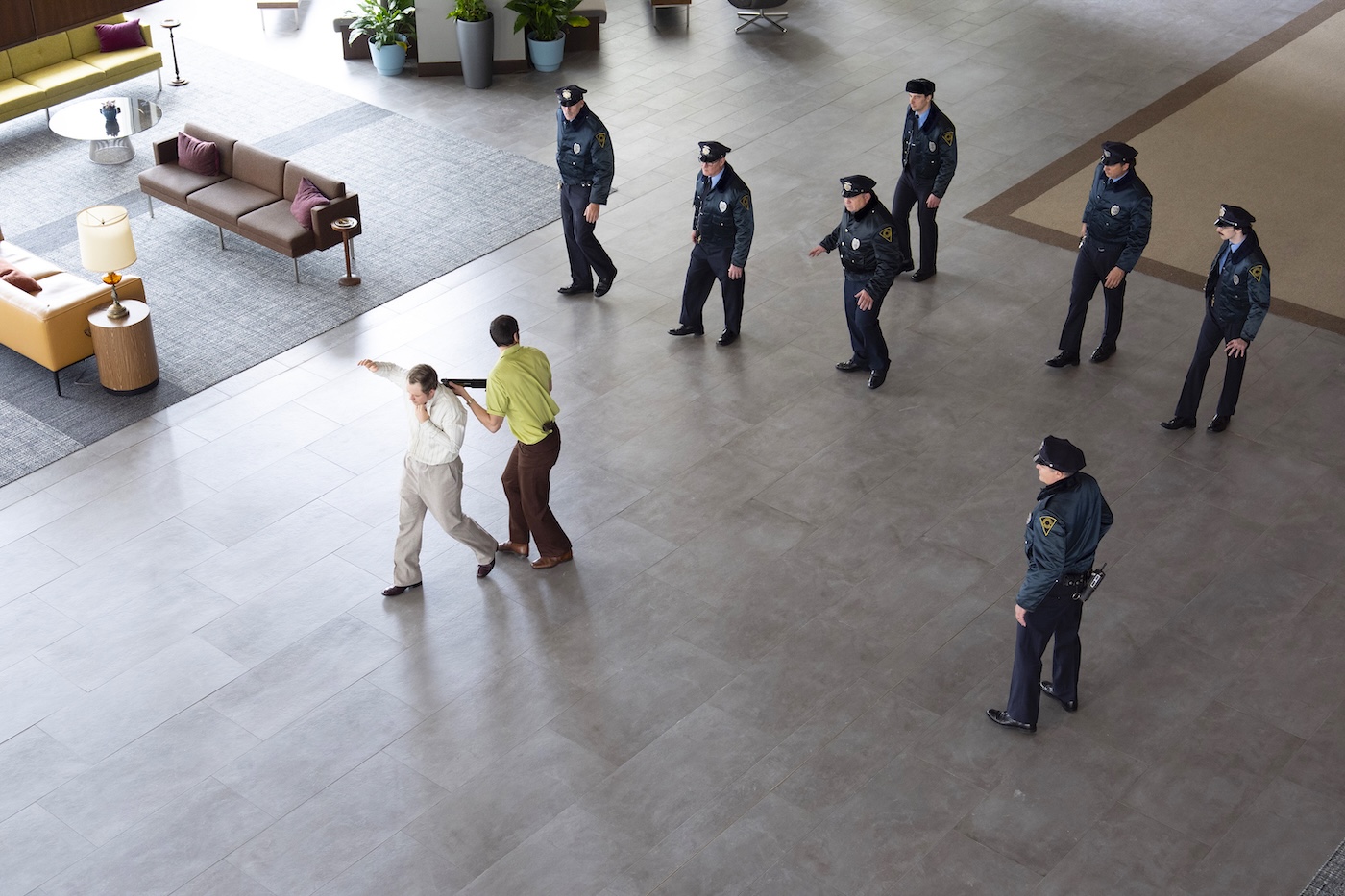
There’s an extended sequence in the opening of Gus Van Sant’s newest feature, Dead Man’s Wire, where the story’s anti-hero, Tony Kiritsis (played by Bill Skarsgård), exits the high-rise office building of the Meridian Mortgage Company with a shotgun leveled at the back of the head of his broker, Richard “Dick” Hall (Dacre Montgomery). Incensed that Hall and his father, M.L. (Al Pacino), have denied additional time to make payments on a chunk of land Kiritsis had plans to develop (so Meridian could repossess the property and bring in their own commercial tenants), Kiritsis wants to make sure the world (via TV news) understands his David-versus-Goliath plight. His plan involves lacing a wire around Hall’s neck to the shotgun’s trigger so that any attempt to escape (or a police bullet finding Kiritsis) would instantly kill his hostage. Kiritsis’s main requests, once the media spotlight is shining on him, are to be compensated for the money Meridian would have made on the property and a personal apology from M.L. Hall for his company’s actions.
As the men push out onto the downtown streets of Indianapolis (doubled by Louisville) circa 1977 and dusted with (real) snow, they’re shadowed by anxious cops, their patrol cars haphazardly parked outside the building’s entrance. Kiritsis walks steadily for several blocks behind Hall, chatting with law enforcement like they’re old friends (which some of them are). Unable to find his own car, he commandeers an idling police car (true story!), telling a detective (he also knows) of the address of his apartment so that “you boys can all just follow me over there, if you want.” What then transpires is a bizarre chase through the streets of a snow-bound Louisville with Kiritsis trying (in vain) to use the car’s P.A. system while his shotgun is jutted against Hall, who is behind the wheel.
The sequence – shot in two days of a 19-day schedule – is remarkably true to life, as news footage of the era reveals. As director of photography, Arnaud Potier, AFC, shares, “What you see in our film is very much how it happened in 1977. Tony wasn’t trying to escape – he had a plan to take Richard to his apartment, and he told the police and news cameras to ‘follow me, as this is where I’m going.’”
Potier, whose feature credits include Skin, for director Guy Nattiv, and Aggro Dr1ft, for director Harmony Korine, along with many high-end commercials, says shooting period films on an indie budget is always challenging. “There are usually restrictions in the frame, with buildings and cars that aren’t period,” he explains. “For one shot in that sequence, after Tony had taken Richard out of the building, we were way down at the end of the street using a Canon 50-1000 [T5.6-] zoom with an extender. That allowed the areas that weren’t 100 percent period to go a little soft as the car drives up towards camera. Inside the car, when the cops were following, we played a lot of low-angle frames so we wouldn’t see too much that wasn’t period. Our 1st AC, Geoff Storts, did an amazing job, as we did just one take on that long zoom. And it’s one of my favorites in the whole film.”
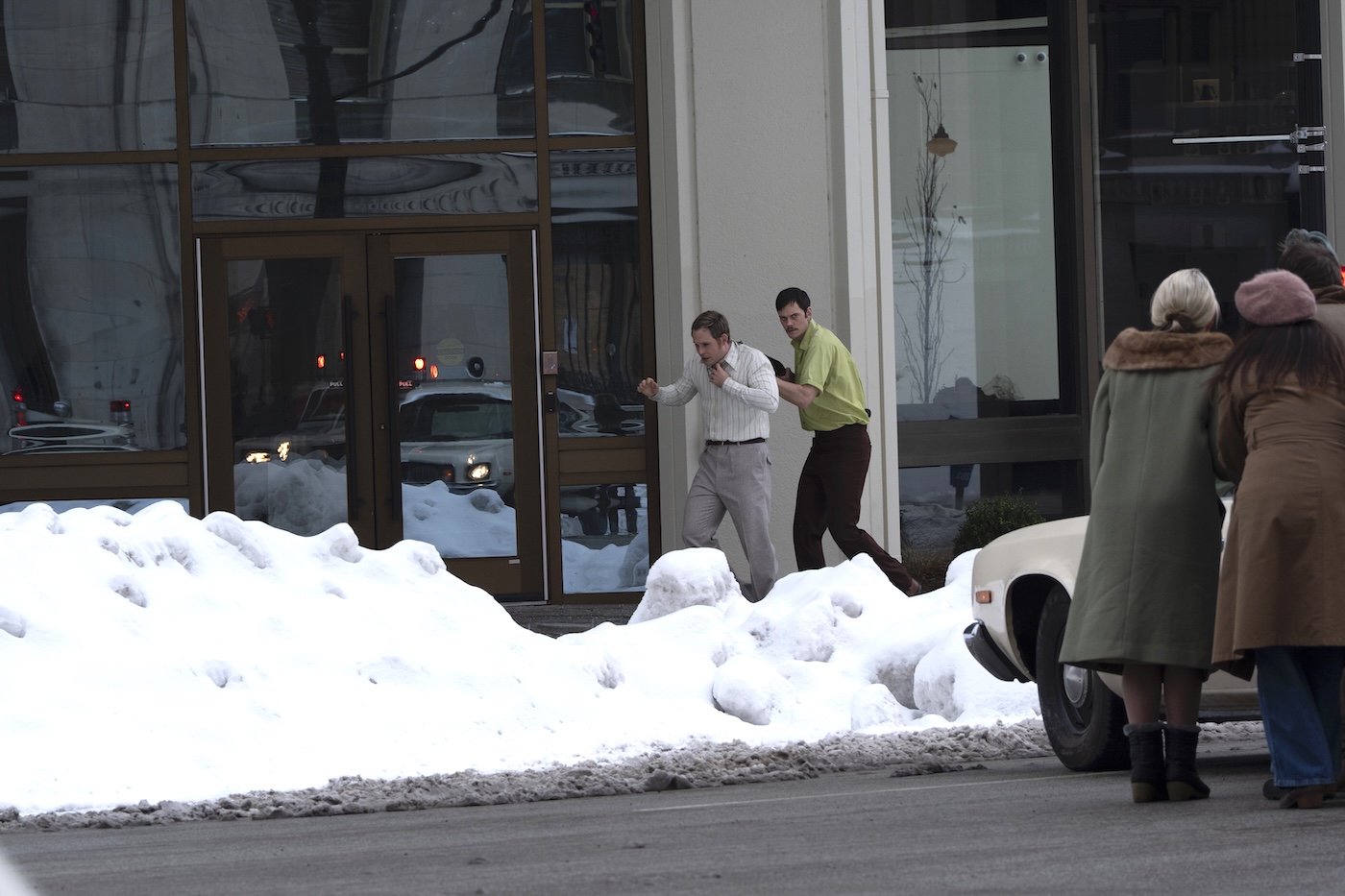
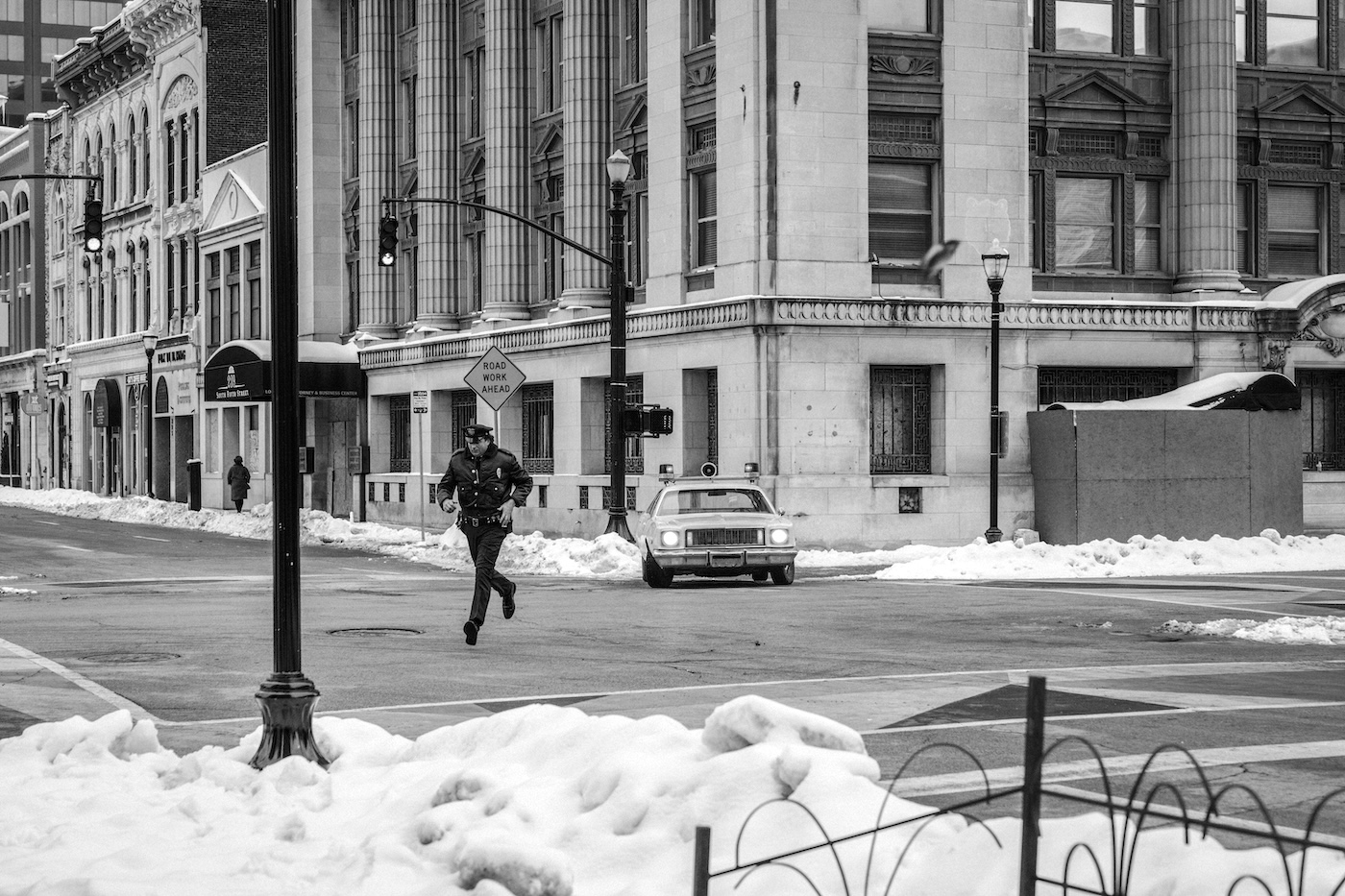
Storts, local to Louisville and a big union booster for younger filmmakers in the city [ICG Magazine August 2025], says the watchwords for his union camera team were to always be fast and expedient. “That sequence was in the first week of shooting, and it covered a large city block,” Storts reflects. “We mapped it all out from the Courier-Journal office building that was our home base to where the car ends up crashing up on the snowbank.”
The Courier-Journal building, much of which is vacant, served as a sort of mini-studio for the production team. It housed sets for Meridian Mortgage, the radio and TV stations, and Tony’s apartment. Storts says the long walk-and-talk outside was accomplished with a lot of delegation. “Our B-Camera Operator [Danielle Bartley] was positioned in an alleyway, and A-Camera Op [Federico Verardi] was down the street with the actors. We couldn’t leave our carts by the building because we didn’t have time to double back. So, it became this giant game of checkers with the cameras hopscotching while our utilities were running back and forth to the truck. One of the biggest challenges was radio frequency and where we could place Gus so his monitor could see both cameras. We were spread out over a big area, in the snow and freezing cold.”
DIT Tim Erickson confirms, noting that “the location did have a small opening between two buildings and across the street from where Tony is walking with his hostage, and that’s where we set up the DIT cart and video village in popup tents. The Art Department helped us out by staging garbage cans and then hiding the front with some additional set decoration. But there was no way the wireless would cover the whole distance, so I needed an RF extender for iris. For video, we were able to run and hide the cable to each receiver on a stand that was carefully hidden and out of the shot. One camera required a 200-foot cable run, while another required our loader to follow and wrangle because we couldn’t find a spot that it would hold for the full run. It was quite the setup.”
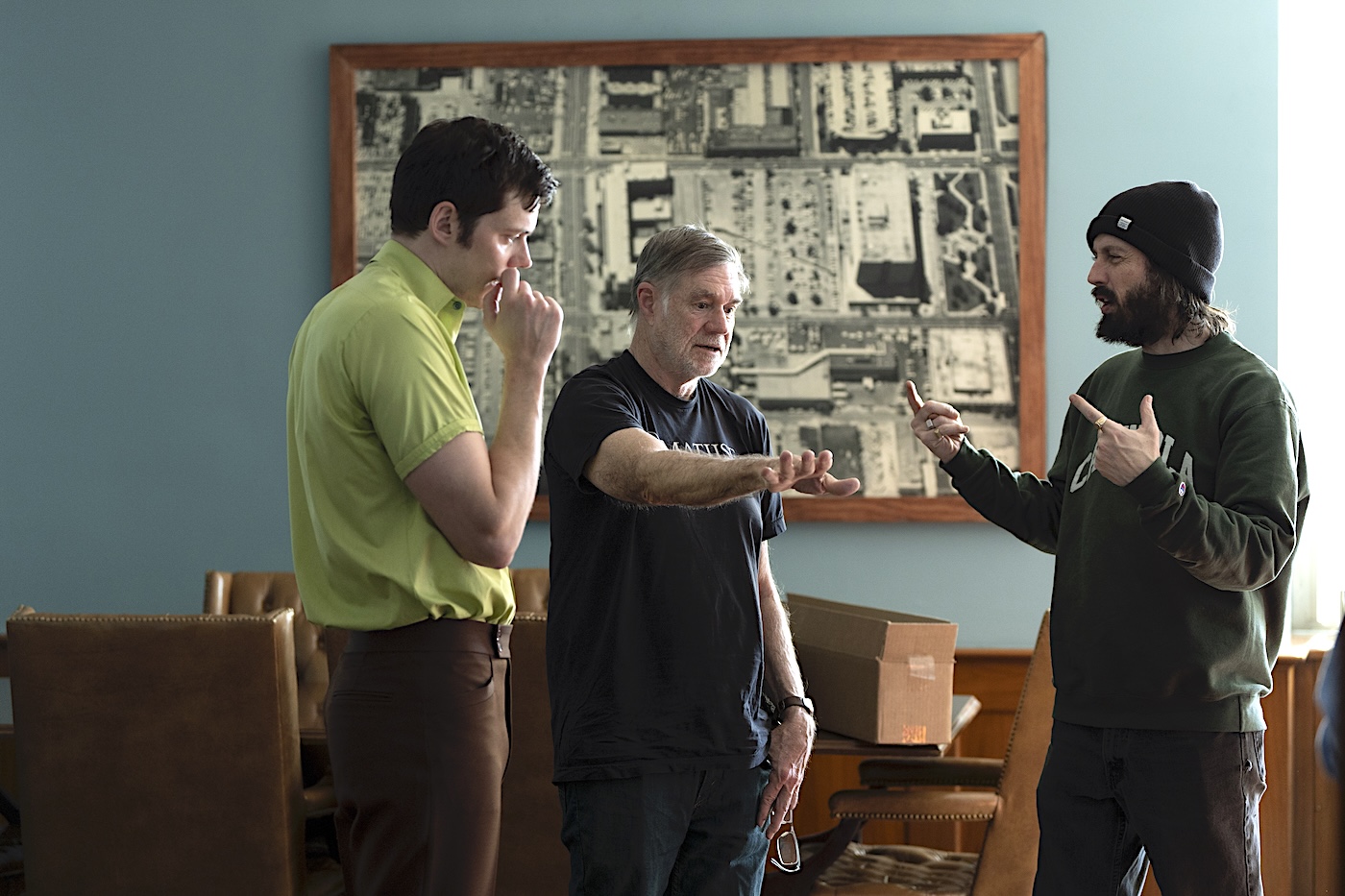
Because Van Sant’s preferred method of working is one take, with few rehearsals or marks for the actors, both Potier and Storts used techniques they’d honed on earlier projects. “I might ask for a second take for lighting or action,” Potier recounts, “as would the actors and the 1st AD. But three takes was the absolute maximum we’d go, and that was rare,” he laughs. “My trick, like with the long dialogue scene when Tony first comes into Richard’s office and takes him hostage, is to relocate the camera on each new angle – wide, close, medium – so Gus had options in editing, even if he only had one take of each shot.”
Coming through the indie film scene in Louisville, “where focus may not always get a lot of attention,” Storts says he’s developed skills to always be ready. “Like reading the sides each day and knowing where the actors will be located, as well as studying each actor’s tendencies,” he describes. “By week two, I’m usually calibrated to what they’re doing. For example, Bill, who is six-foot-five, would often lean into Dacre when he was talking, and I’d know where the threshold was to keep him in focus. I would also calibrate with Federico [Verardi], who was always precise with his movements. Arnaud operated handheld a lot on the [Sony] FX-3 with the Leica Noctilux 50 millimeter, and I got to know when he would like to push into the actors with that lens. With no marks or rehearsals, you’re working mostly by feel, having established a key connection with the actors and your operators.”
For the long zoom Potier references from the opening sequence, Storts adds that “we were full-stick at 1000 millimeters, and then we added an internal 1.5 extender and then a doubler. So, we’re sitting at 3000 millimeters, pulling on cars that were racing toward the camera. You could actually see heat vapors coming off the street. Checking focus, I was like, well, that’s where the bridge is. And then I’d look above the lens, and I could barely see it with my own eyes; we were so far away! It was just the tiniest of movements pulling them through, but it actually came out really good.” Erickson calls the shot one of the most challenging of his entire career. “For the drone coverage that covered the full distance of the drive, [1st AD] Francisco [Diaz] was surprised when I told him I didn’t think we would get a signal from the top of the roof, where the drone team staged halfway through the run, to us on the ground a half-mile away. But my loader and I were able to do a long cable/DA combo to get the RF close enough that it came up before we rolled.”
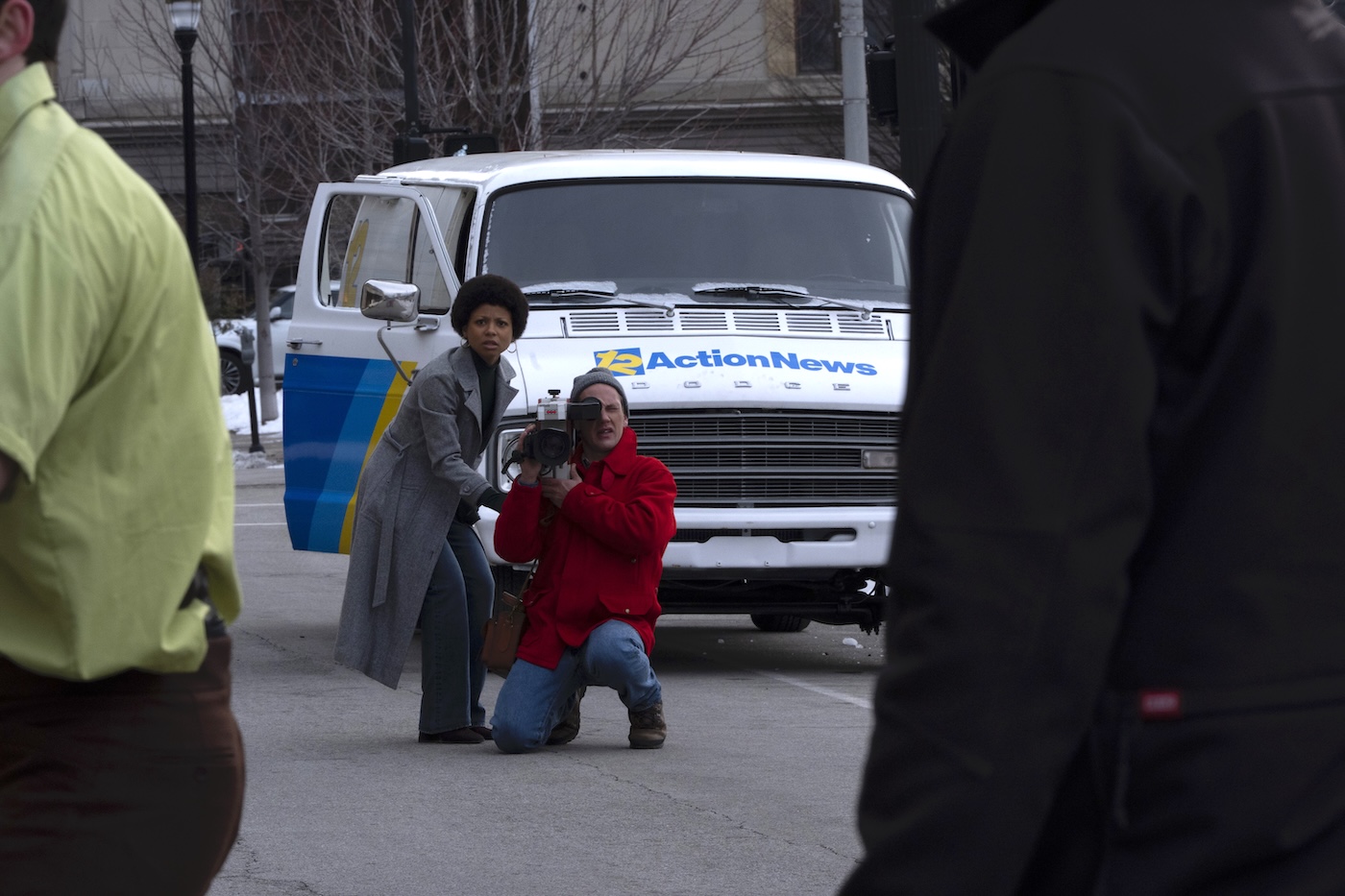
Potier’s history with Van Sant before Dead Man’s Wire was a brief one, having shot a large commercial together that traveled three U.S. states. “We got along well on the commercial, and Gus liked my approach to lighting and camera,” the French-born and raised DP recounts. “Six months went by, and he called out of the blue, saying, ‘I’m starting a new movie. Do you want to shoot it?’ I said, ‘Of course I do.’ But I was shooting another movie at the time in L.A. It was only because of an accident I had that forced me to leave that movie, [which, after recovery and the timing,] allowed me to end up working again with Gus.”
Van Sant says he liked the way “Arnaud designed his cameras when he worked a few years ago on a Harmony Corine film, and I didn’t have any difficulty in communicating during the commercial project. The fit into Dead Man’s Wire, I felt, was at first not possible, as Arnaud was my first choice, but he wasn’t available. Then, suddenly, things shifted, and he was available again. For me, the [DP/Director connection] is often more about the ability to communicate than anything else. Usually, the best course of action for me is the most daring and reckless, and if you can both get into that, you proceed with caution.”
Both Potier and Storts are quick to praise Van Sant’s calm, crew-friendly style but note that his laid-back approach belied a distinct vision for transposing the 1970s style of filmmaking into their modern production. “When Gus sent me the script,” Potier adds, “he also attached the documentary feature [Dead Man’s Line] that was made about the event. Most of that was shot on an Ikegami news camera, and that gave us the idea to replicate that look, intercutting news footage in real time with our Sony VENICE 2 cameras. That approach extended to the set dressing, wardrobe, hair, and makeup – a lot was geared toward bringing the documentary to life, to trying to make it feel like a film that doesn’t so much look like what we remember about the 1970s but one that feels like it was shot in that time.” Van Sant calls the documentary “inspiring for us, especially the colors of those industrial color video cameras of the 1970s. They had a lot of strange greens and yellows that I liked.”
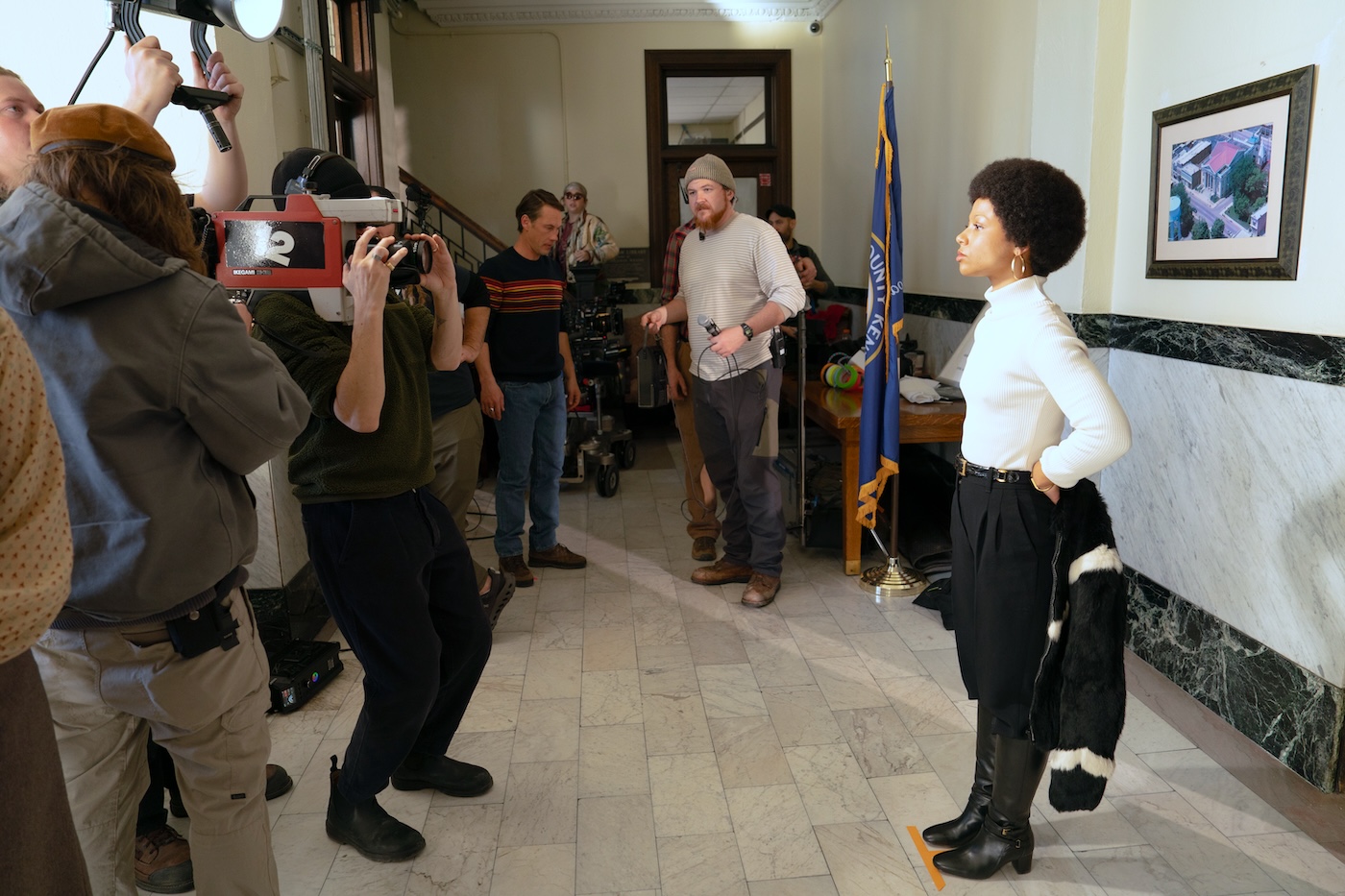
Speaking of broadcast cameras, the Ikegamis (see ICG’s 2022 “Deep Dive Live” panel on Winning Time: The Rise of the Lakers Dynasty) were sourced through Old School Cameras (San Diego and L.A.) on the advice of Local 600 Director of Photography John Matysiak, with whom Storts has a long history (and who co-shot Season 2 of Winning Time). “We didn’t get to prep the Ikegamis until they showed up in Kentucky the first week of production,” Storts shares, “and only then learned that one of them would be on-camera, with the actor playing the news cameraman shooting footage that had to be usable for our film. It was an interesting mix of old and new tech, as the Ikegamis are not built to shoot cinema. Since there was no practical way to remotely control the lens for iris and focus, we relied on the actor playing the news shooter [John Robinson], who had worked with Gus before and knew how to operate a camera. He used the rocker on the lens and did a great job.”
Erickson was “super-excited” when Van Sant and Potier told him about wanting to use the Ikegamis, “as I was a big fan of how they looked on Winning Time, and I have a background in analog electronics.” He says the two Ikegamis were each tuned for a specific look (at the behest of Potier) by Old School Cameras before they were shipped. “On the day they arrived, we built one in our truck-docking bay in 10-20 degree temperatures,” Erickson describes, “and I immediately noticed something was off with the color and focus, plus I saw some ghosting/color blending on bright light sources. It turns out that one of the Ikegamis got knocked out of alignment during shipping. I haven’t tuned an analog device in some time, so initially, I was worried when I took off the side cover to see a large number of adjustment pots,” he smiles. “However, both Gus and Arnaud do an excellent job of giving us room to be creative, and I know that while the technical aspects are important, for them the artistic side is the main priority; at the very worst I knew I just could twist the pots until the look resonated with them, i.e., I knew I was in good hands.”
Erickson set up the on-camera Ikegami with the desired white balance/ISO/gain/iris settings, and, as noted, the actor pulled his own focus. “If John didn’t appear on screen,” Erickson adds, “we would also have an operator shoot more coverage, occasionally on a tripod, but they also pulled focus themselves, keeping with the methods of the era. Since that body often appeared on camera, we needed a way to hide all our modern tech, and luckily, the props department had non-working Ikegamis and plenty of parts, so we mixed and matched viewfinders, lens support, period brackets, and even an old-school tungsten camera-mounted light for one scene. The Ikegamis also had covers with the logos of the TV news channels that we used to hide our AJA RGB converter. Geoff had a period leather camera bag to hide the Blackmagic monitor/recorder, hardware scaler, battery, and cables, so the actor could just grab and go.”
The Ikegami footage proved to be such a hit that Van Sant and Potier came up with a unique concept that the team called “Ikegami Re-Record.” As Erickson explains, “Arnaud wanted to play back footage shot on our Sony VENICE 2s and then re-shoot it with the Ikegami. I did some tests and showed them to him and Gus, and they loved the results. Arnaud, [co-DIT] Sin Cohen, and I then did more tests to come up with a workflow to incorporate the ‘Ikegami Re-records.’ That involved loading the footage into Da Vinci Resolve, outputting it to a large monitor, and then shooting it again using a zoom to emulate the handheld news look. Sin came up with a custom solution to ensure we had proper matching timecode and audio on the re-records, and I came up with a way to color-correct the VENICE footage on the monitor so the look matched as closely as possible. Our last week in Louisville was stage work, so [Utility] Kennedy Cochran and I set up a 24-inch SmallHD OLED monitor that we tented with Duvetyn and played back the footage Arnaud wanted us to shoot. We also had fun creating new footage to emulate the handheld look. Honestly, this is the first time I’ve ever had the opportunity to do something that far out of the box, so I consider myself lucky for the experience.”
Van Sant calls the montage approach (which also included black-and-white and color stills, along with the Ikegami re-records and archival footage) “something that has become how we are used to communicating today. Working in the year 2025, you won’t necessarily be able to completely make it seem like it is 1977, but you have it as a reference and work with the knowledge of 2025 techniques. We were also picking up on montage techniques that were used in the 1970s, like the films La Jetée, Woodstock, or Don’t Look Back.”
Much like how Winning Time’s union crew experimented with camera media, Potier’s ICG team employed as many as seven capture systems (rarely all at the same time). Those included two Sony VENICE 2s as the A/B cameras, shooting full-sensor 8.6K, 3:2 mode (cropped for a 1.66:1 final aspect ratio); the small footprint Sony FX3 as a C-camera, recording internally to the highest bit rate, XAVC I frame mode, in 4K. Erickson says he would typically record RAW to an external recorder, “but Gus really liked the look when Arnaud went handheld with the minimal FX3 build, as he could get very close to the actors and hold it with one hand. That caused a subtle but real difference compared with the larger VENICE, even in Rialto mode. The ISO was 1250-1600 because we saw that the more compressed codec was a better match to our VENICE 2, texture-wise.”
Other cameras included a DJI Inspire 2, recording in 5K, Cinema DNG RAW, with ISO adjusted for the stop; the two Ikegamis, with different gain settings instead of ISO, “but we typically stayed at the 0 and +9 modes,” Erickson adds, “as +18 was just too noisy and fell apart too much. They had different white balance settings like 3200K and 5600K for daylight, plus a daylight and ND mode. We had zooms for these, a long and short B4 broadcast zoom.” The final camera, a Sigma, was nicknamed the “Gus” cam, which Van Sant wanted to use for stills. It had a video mode that the director could use to shoot inserts, but it was mainly used as a viewfinder and communication tool. The team did roll a few times on it, though in 4K, to internal cards in H.265.
Potier’s go-to lenses were a full set of never-used Richard Gale Optic Clavius that required Storts to spend more time in prep making sure they were on point; the 50 mm Leica Noctilux, T 0.95, used on the FX3; as well as a full set of vintage Canon K35s, both for the look and because they were faster at T1.4 than most of the Clavius (helpful on night exteriors). Potier opted to use 1/8 or 1/4 smoke filters on the main cameras. He also employed POLA filters and a set of diopters, mainly for the night exteriors. A full set of ND was used on the FX3, with the internal ND in play for the VENICE 2. Verardi brought his own Ronin and Black Arm, which was rigged to a car/crane combo, when Kiritsis leaves Meridian, as well as a stairwell scene when he finally exits his apartment with Hall.
A courtroom scene at the end of the film portrays Kiritsis (found guilty by reason of insanity) exiting the building and getting into the police vehicle as it drives off, with the camera lingering on his implacable expression. Potier designed the scene as a oner with Verardi in the courtroom on the 4th floor, then leading Kiritsis all the way outside and into the car that drives off. “It was a tough shot,” Potier recounts, “as Fedi had to walk backwards down four full flights of stairs, out the door, down the exterior court steps, and then stand on a special rig the grips had created on the car. It was shot on the FX3 with a special handheld cage that had remote focus, iris, and Vari-ND motors.” Erickson adds that “it was challenging for all involved, since there were large stop changes going from the courtroom to the stairwell to outside to the car, then staying on him as it drove. We set up a variable ND on one motor and iris on the other, so it was a dance keeping exposure and focus. For some parts, Geoff was pulling on a T0.95, and for others it was a 2.8 or 5.6, so he really had to be on his toes.”
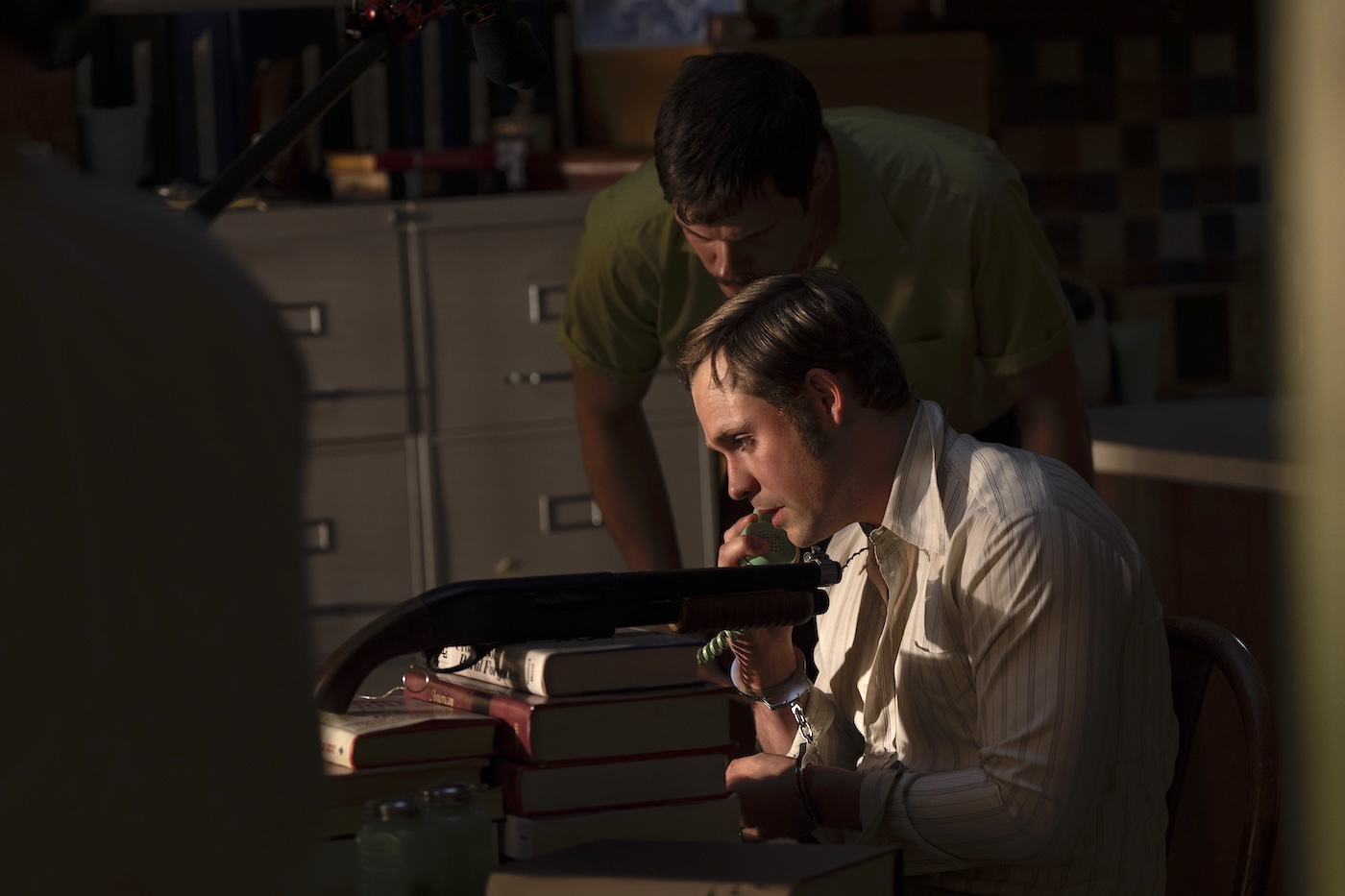
Production Designer Stefan Dechant [ICG Magazine January 2022], currently prepping James Gunn’s next Superman film in Atlanta, was connected with Van Sant through Dead Man’s Wire’s costume designer, Peggy Schnitzer, with whom Dechant had just finished the Ethan Coen-directed Honey Don’t! “The films I was looking at for reference,” Dechant shares, “were Dog Day Afternoon, The Taking of Pelham 123, Network, All The President’s Men, Taxi Driver, and The Shining. Those all took place in the era they were made, and they share an honesty about that time period. There’s a tendency now to fetishize what the 70s looked like. For example, it wasn’t all earth tones – there are scenes in Taxi Driver and All The President’s Men that have bright, bold colors, and I thought we had to be open to that approach. What I wasn’t expecting was getting a photo from Gus of Tony Leung’s office from In The Mood For Love, saying that he envisioned that look for Tony Kiritsis’ apartment. That’s a Wong Kar Wai movie from 2000, so it definitely threw me for a loop!”
Dechant called up an illustrator friend to create a look for Kiritsis’ apartment that utilized elements of that photograph. “The other thing that crystallized my approach,” the designer continues, “was visiting Gus at his house and seeing all the art he’s made. I thought, ‘This person is a painter, and he’s going to look at this film with that eye. I grew up in Cleveland in the 1970s, and it’s very similar to Indianapolis, so I had a preconception from my own memories. But Gus’s inspirations were more eclectic; for example, he brought me a William Eggleston photograph of a mural that he said would be great for the background in the TV station. His instincts took me to areas I never would have gone, and the design of the film was the better for it.”
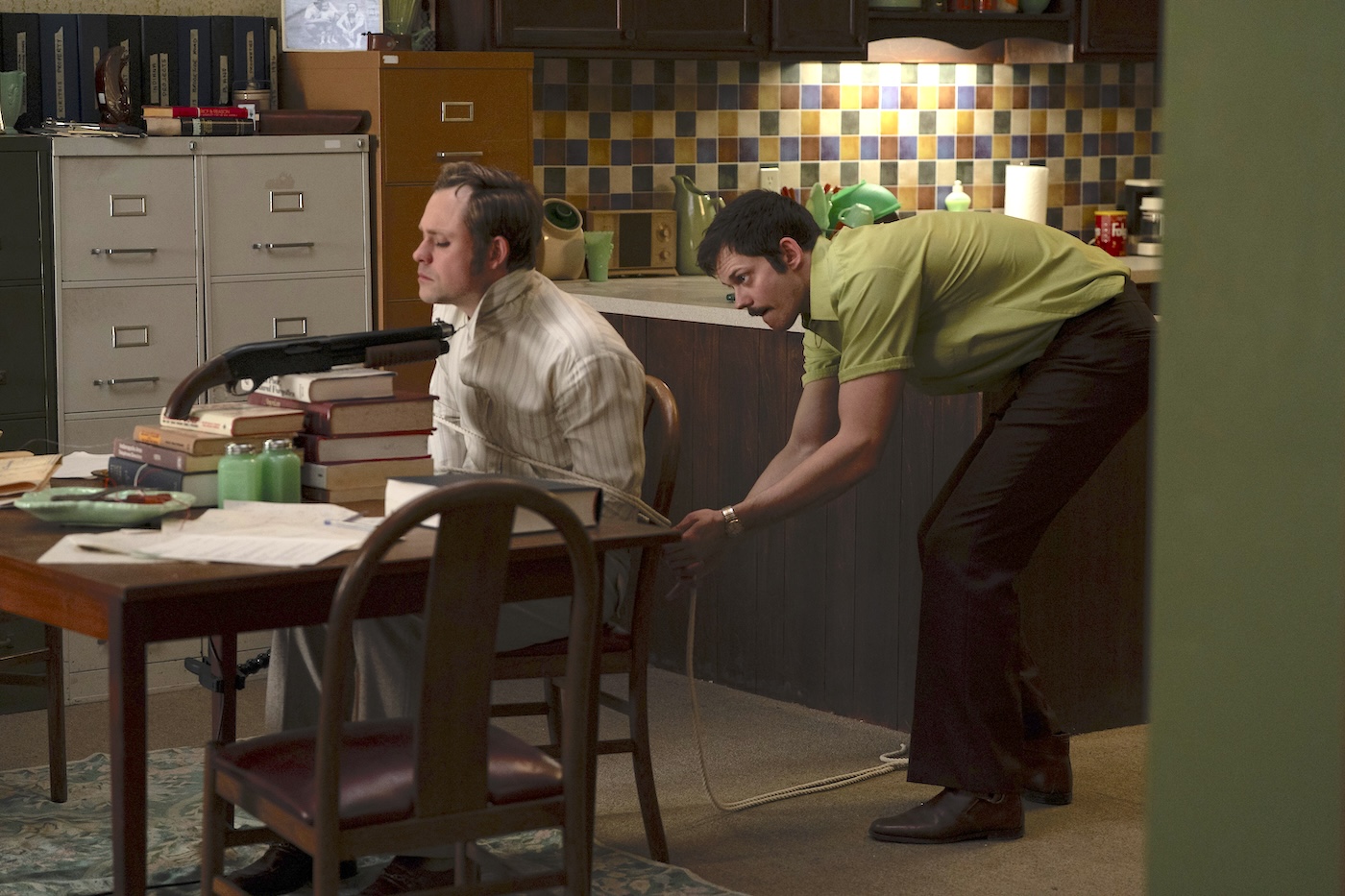
A large chunk of Dead Man’s Wire takes place in Kiritsis’ tiny studio apartment. The action begins during the day after he brings Hall inside, and spreads into dusk, night, and day again (the real event was spread over 63 hours!), when the pair finally exits to attend a climactic press conference. Most of the dialogue takes place around a single table where Richard is seated, with Tony moving from the large window to the kitchenette behind his hostage. Dechant designed the apartment set in an L-shaped configuration to give Potier some depth in his framing and lighting choices. “I wanted to play with color so we weren’t just in a brown and green room all this time,” Dechant recounts. “I thought of Scatman Crothers’ bedroom from The Shining, which had a coral color that we aged down. I also designed wild walls on wheels, so Arnaud had options and could work quickly. I try to plan my designs to give the DP as much flexibility as possible, particularly on a film of this size and budget.”
The apartment set was built in the basement of the Courier-Journal building. Dechant put it on risers so Potier could light from below to mirror the police lights shining up into the apartment’s only window. Both Dechant and Potier lobbied to place an exterior backing beyond the window to help sell the distance down to the ground, which became a human circus of police, media, fans of Kiritsis as the underdog hero, and eventually Tony’s brother, Jimmy (Daniel Hill), who helps broker a deal for his surrender.
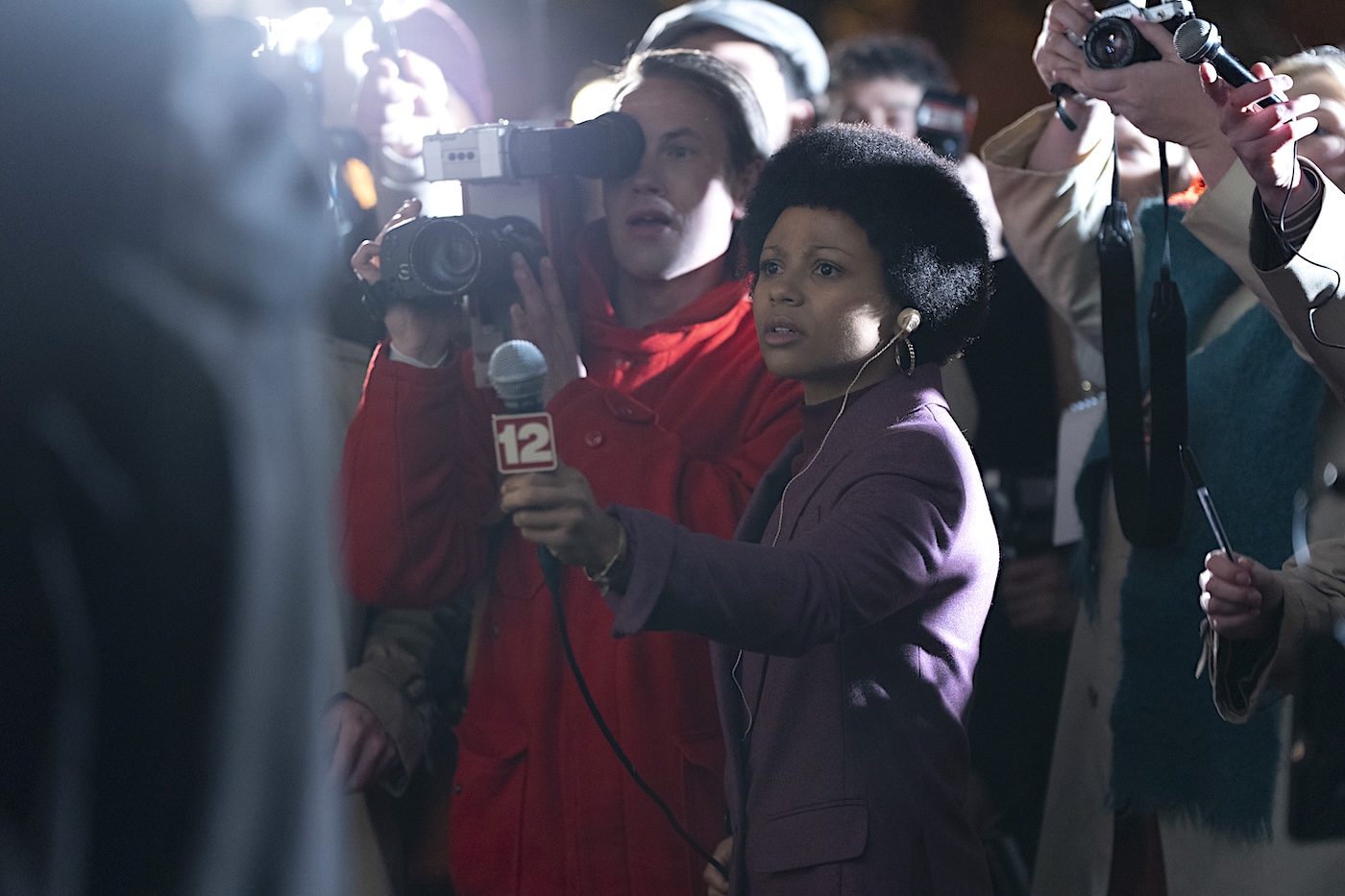
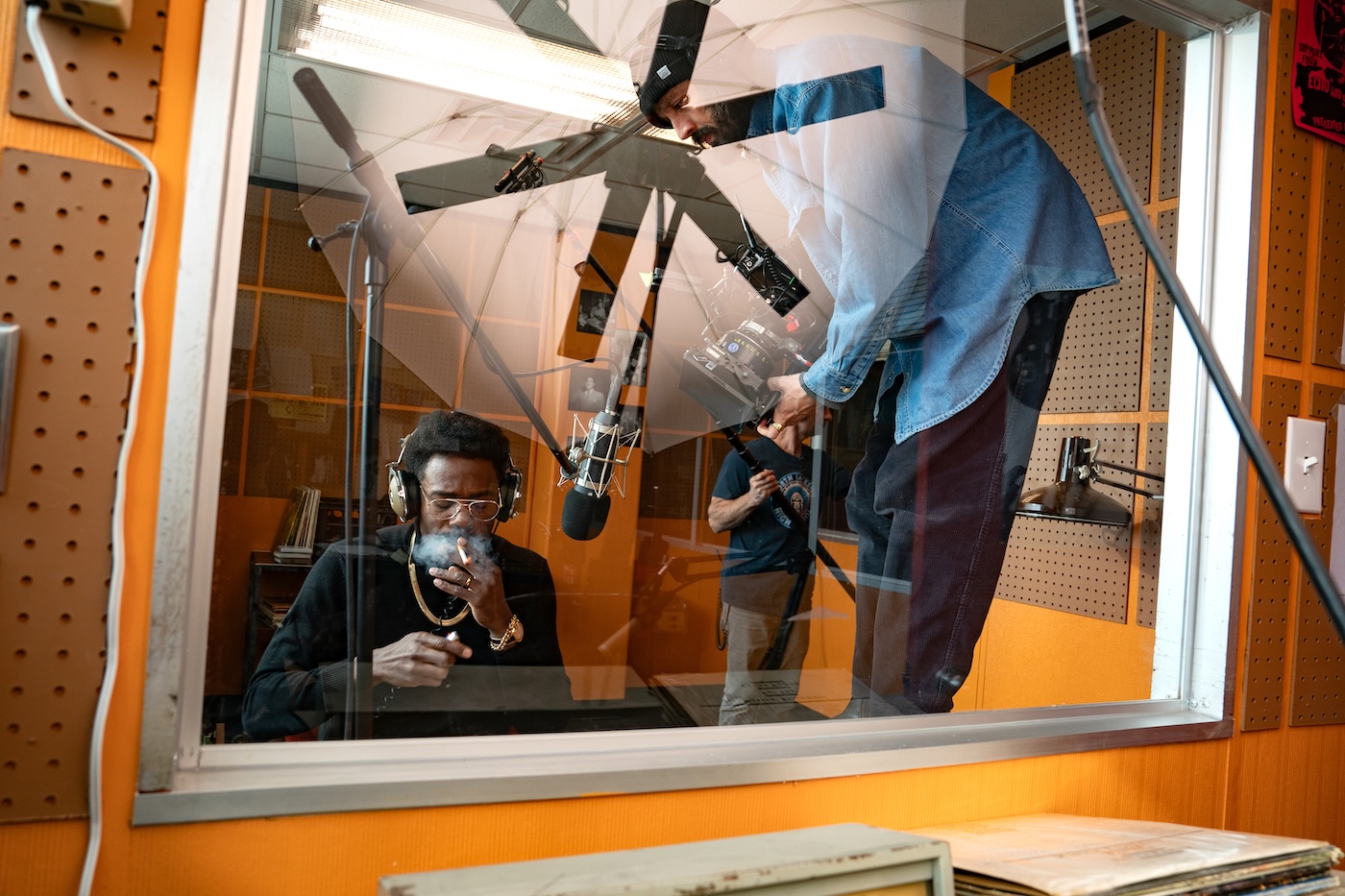
Potier explains that the color palette he used was key to making the story feel like it was shot in the late 1970s. “The exteriors, with the snow, were a bit desaturated,” he shares, “and wherever there was red, I tried to get it as close to film as I could. Inside Tony’s apartment was a warm, greenish feel. The radio station [where jazz station DJ Fred Temple, played by Colman Domingo, becomes Kiritsis’ main conduit to the outside world], I wanted to have lights coming from underneath, bounce, and practicals, because all the lighting is on tables and desks – nothing from the ceilings. We lit his apartment from above and through the windows.” Dechant says the radio station was another find inside the Courier-Journal building. “I told Gus and Arnaud there’s this strange room on the 7th floor with wallpaper and mirrors that looks like it was designed by David Lynch,” he describes. “The radio station was basically a three-walled set, and I was trying to just give Arnaud as much room as I could. We knocked holes in adjoining rooms to create Colman’s DJ booth and the engineer’s room. We couldn’t afford the massive record collection they would have had at that time. So, we bought fifty to seventy-five records and had the art department photograph them in different configurations. We printed them out like wrapping paper and folded them into paper boxes. Those got shoved into the set and appeared as rows and rows of albums.”
Potier used all period lighting, tungsten, and HMIs, save for one large Aputure LED LiteMat in the TV studio to break up the blacks. “We had three days to shoot all of Tony’s apartment on stage,” he states, “and because so much time goes by – dusk, night, day again – I relied on Francisco to help us with the scheduling. After that, it was mostly about swapping heads, changing colors on gels, and adjusting the calibration of the camera to fit the time of day. We always wanted to feel the pressure of the police shining lights up into the apartment [on the third floor], so we used elements mounted on rigs that could slowly turn to give the feeling of light sweeping across the window. It cost more, but Stefan and I wanted the set raised to get that feeling of uplighting from below.”
Storts says, for him, the lengthy apartment scenes were a challenge of a different type. “The set was very small, and Arnaud lit it 360 degrees to give the camera freedom to follow Tony around,” he remembers. “That meant I had to be outside the set build in this small corridor. I had a diagram from the art department with measurements of how Stefan had designed the room and where everything was. I’ve pulled focus remotely before, but this was unique, as I was very close and could hear all the dialogue. I relied heavily on my Focusbug CineRT because when it’s calibrated into the center, you get an error message [when you’re off] and can quickly find your way back to where you need to be. The Focusbug integrates into the [handheld wireless focus unit] ARRI Hi-5, which helped keep the builds small for the FX3. Our A-camera VENICE was always built out onto the Rialto. That way I could have the RF motor on the front of the camera with no need for an MDR box.”
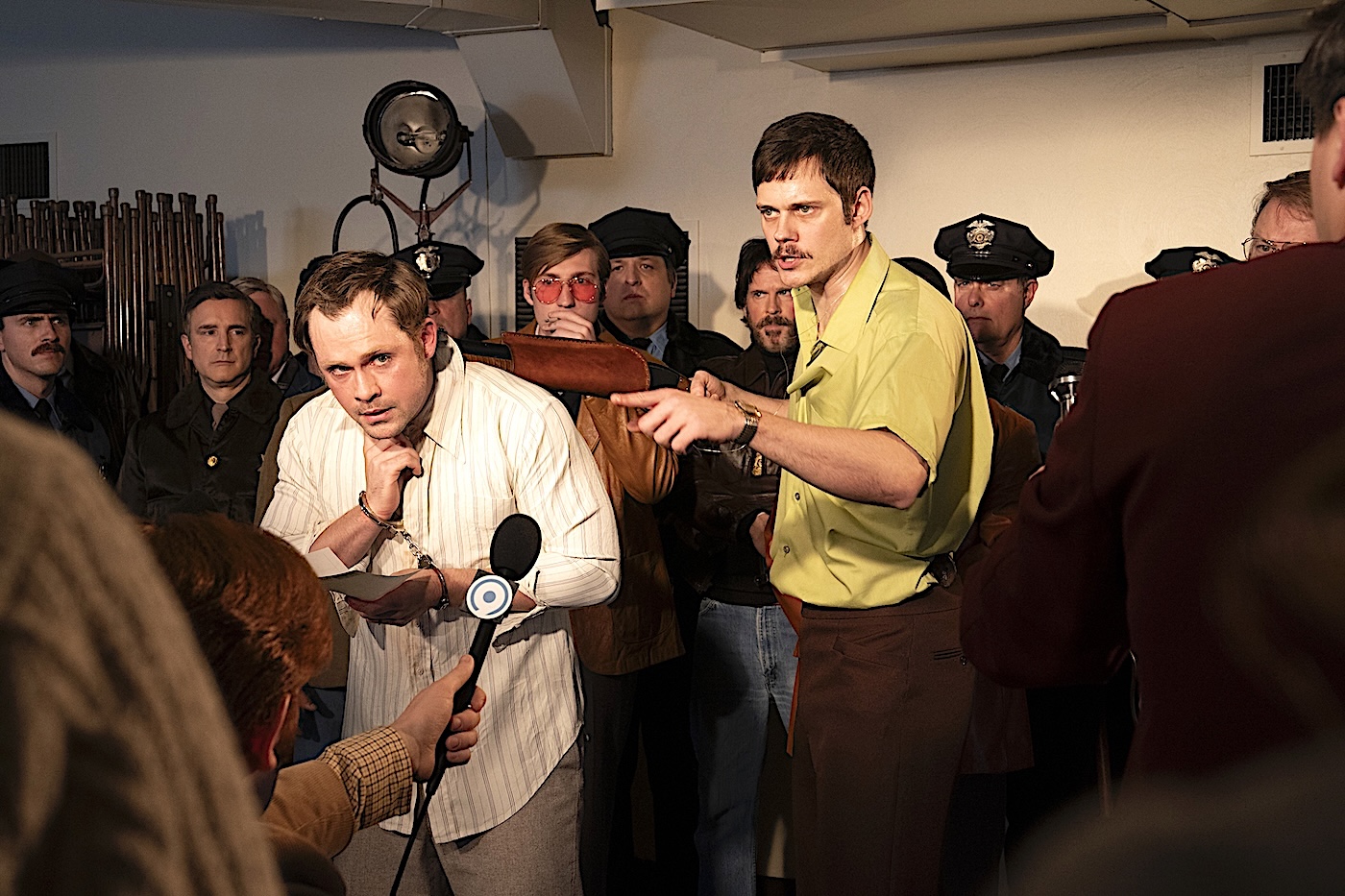
Eventually, Kiritsis is lured down from the apartment, based on his belief that his terms have all been met, including full immunity from prosecution. Potier says when he makes his way down the stairwell with Hall to give a press conference, “We kept the camera handheld to give it this kind of urgency. They’ve been in the apartment a long time, and now suddenly there’s energy and movement. Once the press conference started, we pulled back and used a static, straight-on camera angle, like the real news cameras. We had 1K or 2K lights from the period shining into people’s faces with a hard, open-faced light, just like what was there at the time. I managed to find some flashes with the bulbs, like the still cameras would have been doing, but those were quite expensive, so we couldn’t do too much.”
In keeping with the documentary, the press conference was meant to look rushed and uncinematic. As Potier reflects on the single-source, hard lighting, “Of course it can be ugly with a single open-faced bulb shining into the lens. But you find the beauty in creating something that looks and feels real. Our job is to sell the story, not just make pleasing frames.”
Storts recalls how the press conference was shot in the basement of a local church, “with no elevator, and in a small space. They threw up prop cameras alongside the real cameras, so we didn’t have to hide our cables,” he states. “We also hard-lined everything, which helped to sell the look.” Storts adds that“whenever we were on the Canon zoom, it was assumed we were the POV of one of the news cameras, and I would try to do what news crews did in the documentary. They’re handheld, and you can feel the operator rocking the lens to search for focus. In fact, Arnaud would tell me not to make the focus ‘too perfect,’ which is not something an AC is used to hearing,” he laughs. “When Bill and Dacre came down the stairwell [from Tony’s apartment], we were on FX3 with the Noctilux wide open – the whole movie was shot wide open – and we were inches from their faces. There was no way I could maintain critical focus walking backwards on a T.95, so after we did a take, I told Arnaud I would need another one, as parts of the action went soft. He was like, ‘No, no, that’s perfect. It will look great.’”
Erickson says that cabling hard lines out of both Ikegamis for the press conference “allowed us to let Gus see everything at once. If you point the Ikegamis for a long time, like a static shot on a tripod, and the exposure is on the bright side, when you pan, there will be an afterimage of what was burned in, with the intensity related to brightness and time spent hitting the tubes with the same signal. In keeping with the period, Arnaud used mainly hard front lighting, but there were some backlights that could be seen in frame as well. To get around the burn-in/ghosting effect, we exposed them a bit lower, and the actors naturally would cross the hard backlight, so we didn’t have that strong source constantly oversaturating the tubes.”
As to the large amount of handheld camerawork, Potier says, “Gus fell in love with the Sony FX3/50-millimeter Noctilux combo “because the FX3 has some internal stabilization. We could push in very close, like the scenes in the radio station with Colman Domingo, and it felt smoother than normal handheld. I’d estimate that about half of the movie was shot with the FX3 at 4.5K, which is kind of incredible, if you think about it.” Storts says Potier and Van Sant talked in preproduction about the benefits of a tighter turn radius using the FX3 and/or the Rialto. “It gives the operator a different feel when doing a whip pan, like the scenes in M.L. Hall’s office at the beginning or later in Tony’s apartment,” Storts describes.
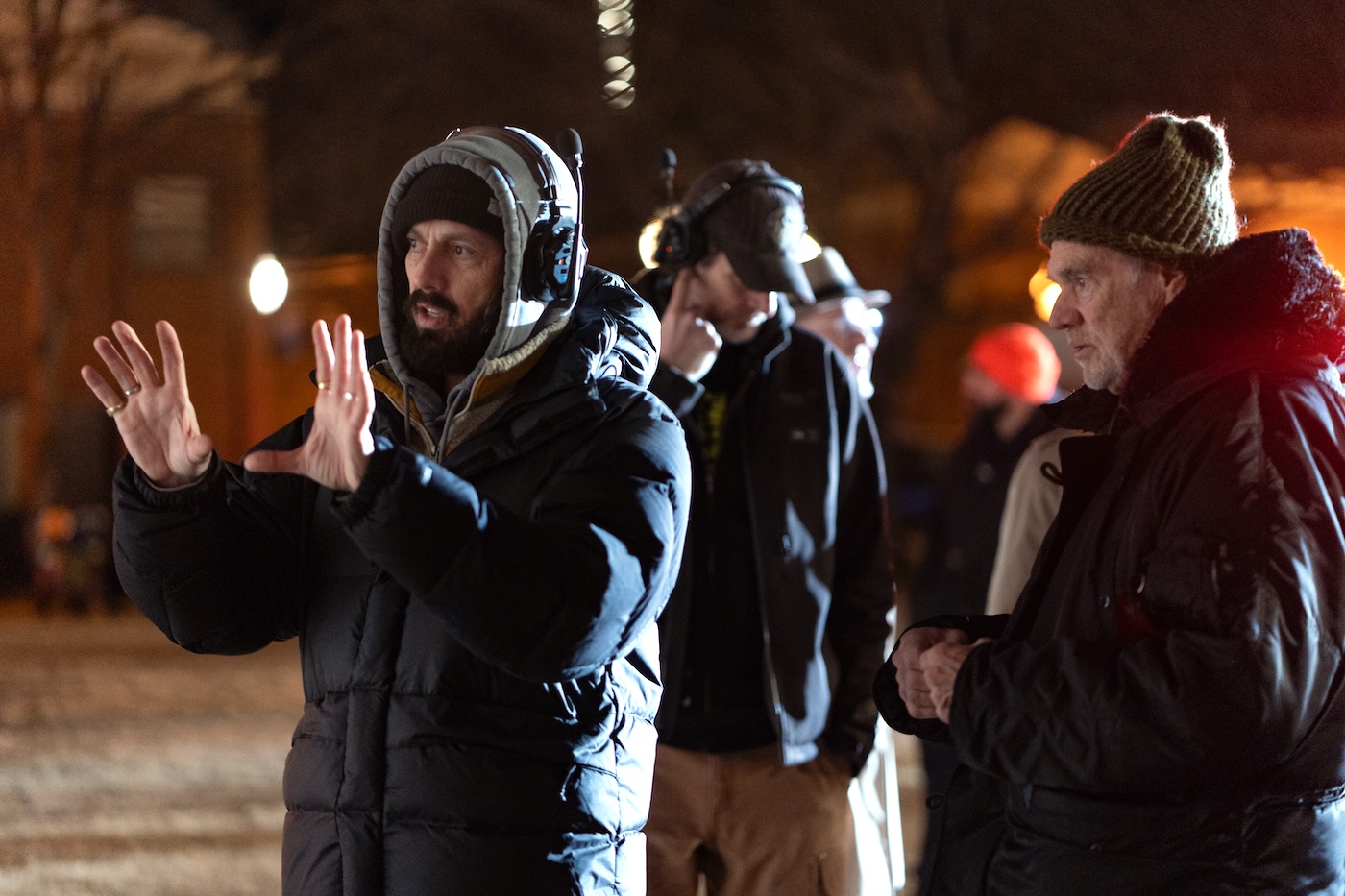
Potier says that Van Sant’s style encourages unity on set. “Everyone loves to work with him because he’s so respectful of us as creative people,” Potier explains. “One thing for sure is that he doesn’t waste a second of your time. He shoots like he has film in his camera! With Gus, Take One is really the take, and that’s an interesting way to work because everyone is on their game the moment he calls action.” Storts describes the director this way: “There’s a sense of implicit trust that we’re all capable professionals and will do exactly what we’re expected to do,” he offers. “I remember when we were shooting the radio station scenes. We had this extremely close shot of Colman Domingo in the microphone, similar to the opening shot of The Warriors [1979, shot by Andrew Laszlo]. They wanted to do it on the Leica; we had a plus-three, which still wasn’t close enough for Arnaud and Gus, and we were out of diopters. I told them I could break the matte box apart and rebuild it to squeeze in another diopter to get even closer. Arnaud asked me how long it would take, and I said 10 minutes. He went to Gus, who said, ‘If it makes it better, let’s do it!’ No meltdowns, no drama. Just implied trust in my word that I could get him what he wants.”
Storts says the work filtering through Louisville is mainly Tier One indie features, much like Dead Man’s Wire. “We get smaller commercials, the occasional music video,” he shares. “But with films like this one, I think producers are seeing how fast and capable our crews are,” Storts says Dead Man’s Wire is a testament to the growing confidence in smaller, regional markets. “That first day of production,” he continues, “in the bitter cold, trying to keep pace with just one camera, was one of the hardest days I’ve ever had on set. And it was clear that we needed a B-camera to survive – logistically, physically, and in every possible way. So, I asked the producers, and they approved it.”
The AC brought in Louisville-based Emily Keenan as B-Camera 1st AC and Danielle Bartley as B-Camera operator. “We bumped up our utility, Gillian Sparks, to 2nd AC, and brought in Kennedy Cochran as our utility,” he recounts. “These are people who are still in their 20s, who are unbelievably good and would excel in any market. But they’ve chosen to work here alongside me, and I am so grateful for that. I remember I called Emily at the end of that first day because we were getting our asses kicked. I said, ‘Do you think you could come in tomorrow?’ And she said, ‘Sure. For how many days?’ And I said, ‘All of them!’ The movies may be small in budget, but we’re working with filmmakers like Gus Van Sant and Ethan Hawke. That kind of experience leads to pride in work, which leads to pride in our union, and it just keeps rising from there.”
Unit Production Manager Veronica Radaelli, who has shot nine movies in Kentucky, says that as soon as Van Sant came on board, she knew Louisville was the right place and had the right crew for the director’s approach to moviemaking. “I always say they are not only crew, but they are all filmmakers who care about the project and love the challenges,” Radaelli states. “Besides Arnaud, I brought in a few trusted people [from L.A.], like [Unit Stills] Stefania Rosini, [A-Camera Operator] Federico Verardi, and [DIT] Tim Erickson. Everyone was able to blend in and trust each other right away, despite budget and scheduling limitations, and extremely harsh weather. This crew came to set every day, excited and with a smile; they went above and beyond, and I will be forever grateful for the amazing work they did. I don’t think I could have made this movie anywhere else.”
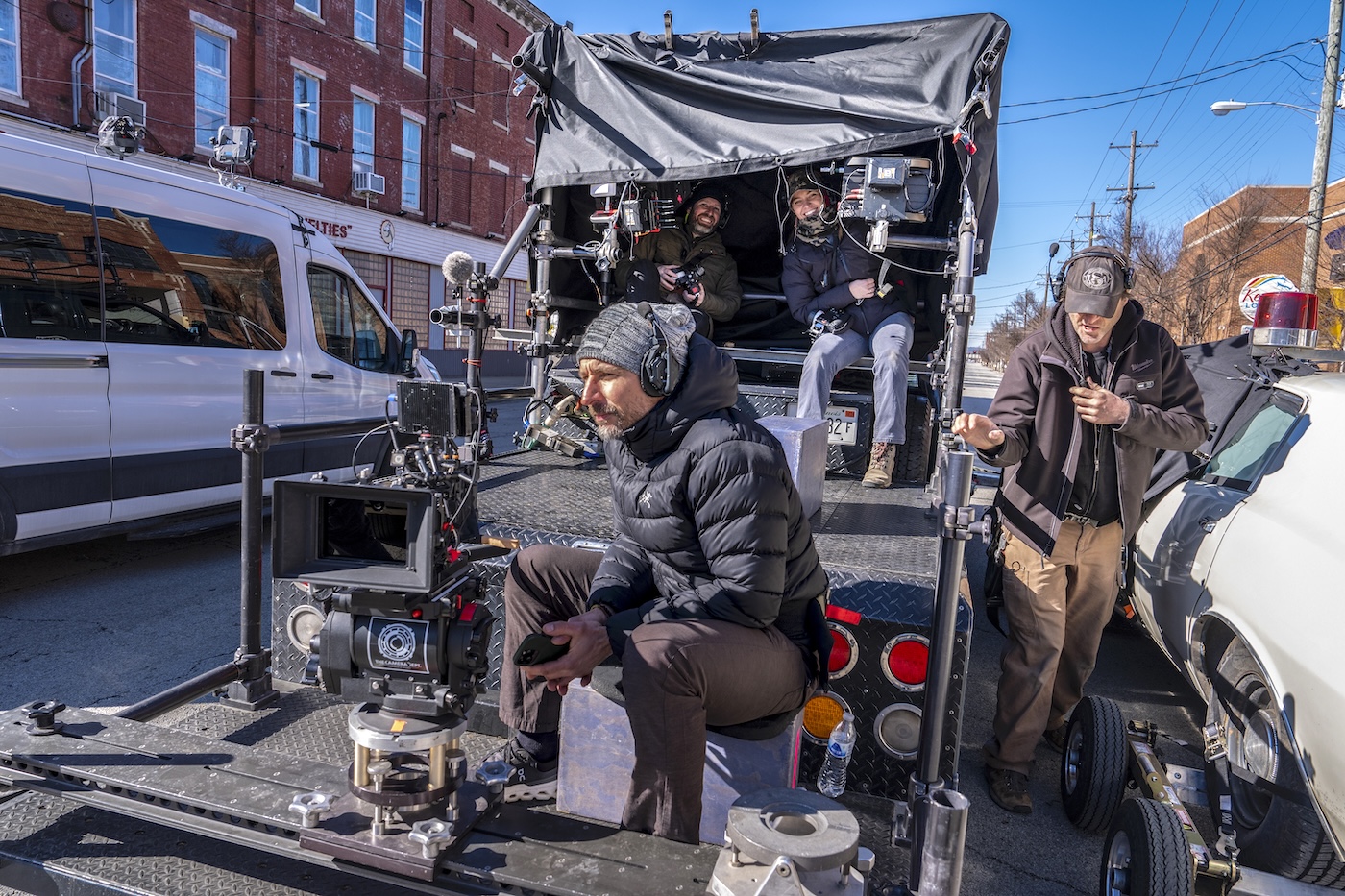
Dead Man’s Wire– Local 600 Crew