
by Kevin Martin / Photos by Melinda Sue Gordon / Framegrabs Courtesy of Apple TV
The 2018 Butte County Camp Fire ranks among the most destructive blazes in California state history. Beginning after high winds took down inadequately maintained electrical lines, the resulting burn lasted for weeks. It spanned more than 150,000 acres, took nearly 100 lives, and, most famously, almost leveled the town of Paradise (population 17,000 at the time of the blaze).
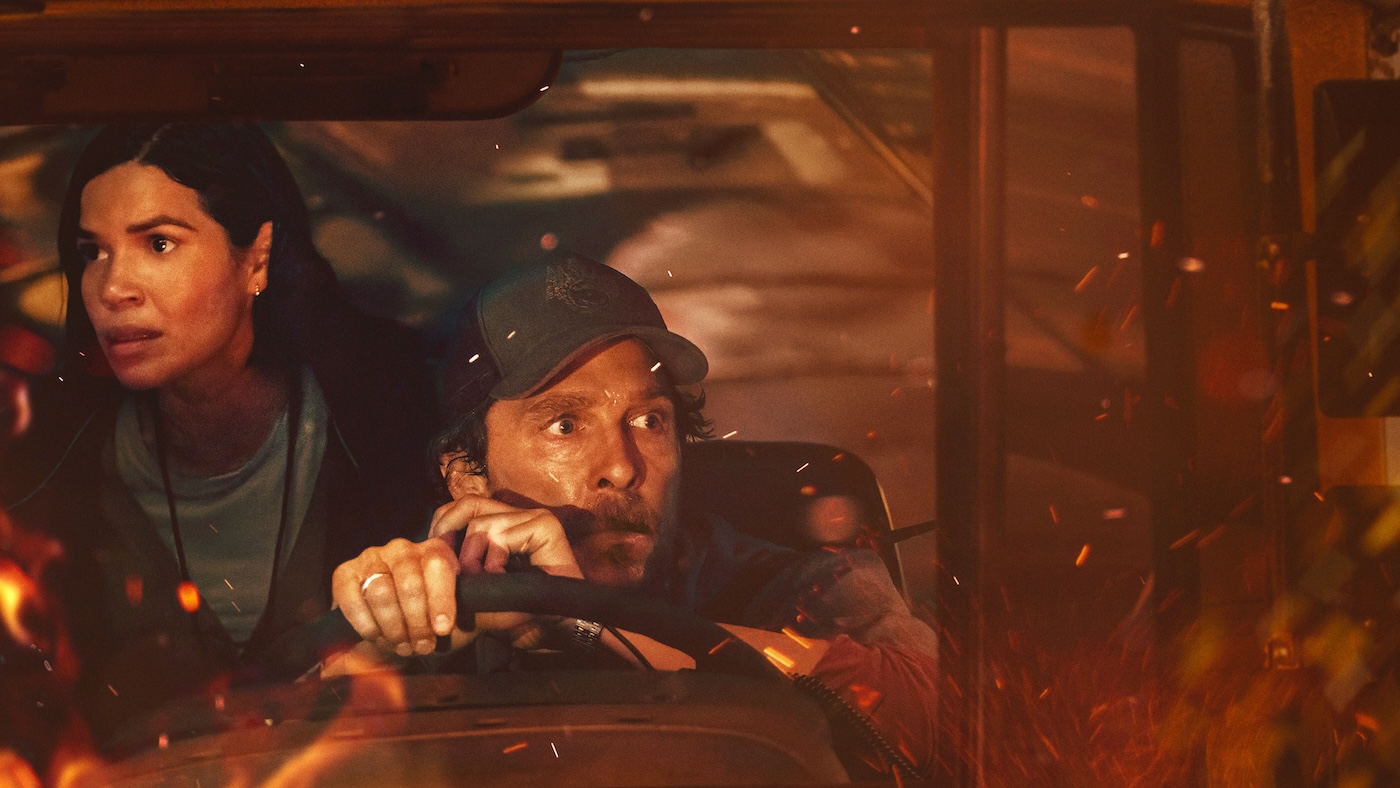
Producers Jamie Lee Curtis and Jason Blum obtained the rights to journalist Lizzy Johnson’s book Paradise: One Town’s Struggle to Survive an American Wildfire, which documented the event, choosing to depict the struggle of bus driver Kevin McKay (Matthew McConaughey) and elementary schoolteacher Mary Ludwig (America Ferrara) driving a group of students to safety. They then approached a filmmaker known for both documentary work and a handheld vérité style in his narrative films, director Paul Greengrass. With credits including dramatizations of real-life events in United 93and Captain Phillips, plus multiple entries in the Jason Bourne film series and, more recently, News of the World (ICG Magazine December 2020), Greengrass seemed a logical choice.
Previous cinematic efforts to depict major fires and the efforts to quash them include Steven Spielberg’s Always, with most of the action coming from an aerial perspective, and Ron Howard’s Backdraft, which captured a firefighter’s eye view of urban infernos (both films were shot by Mikael Salomon, ASC, DFF). More recently, Joseph Kosinski’s Only the Brave (shot by Claudio Miranda, ASC) dramatized the 2013 Yarnell Hill fire in Arizona. A mix of practical and visual effects figured prominently throughout all of these previous films, which The Lost Bus continues while also retaining another key component: Industrial Light & Magic, the principal VFX vendor for each movie.
Greengrass’s choice as his director of photography was Pål Ulvik Rokseth, FNF, who also shot the director’s 22 July. In addition to a variety of international credits, Rokseth has also shot TV projects, including the initial installments of The Continental as well as Defending Jacob. “When I first read the script, I was thinking about how to do this,” Rokseth recalls, “and how to do it in a way that reflects Paul’s way of working, telling a true story that feels real. Some of that relates to capturing whole scenes in a documentary fashion rather than proceeding with a more conventional shot-by-shot basis. And doing these long takes with smoke, fire, and kids … well, it required a lot of collaboration. We were fortunate that Producer Greg Goodman took on a lot of people early in prep to discuss doing things with practical effects, as well as VFX Supervisor Charlie Noble, who had a great team around him to develop ideas for Paul. There was a lot of previs done, including a couple of lengthy bus runs from ILM.”
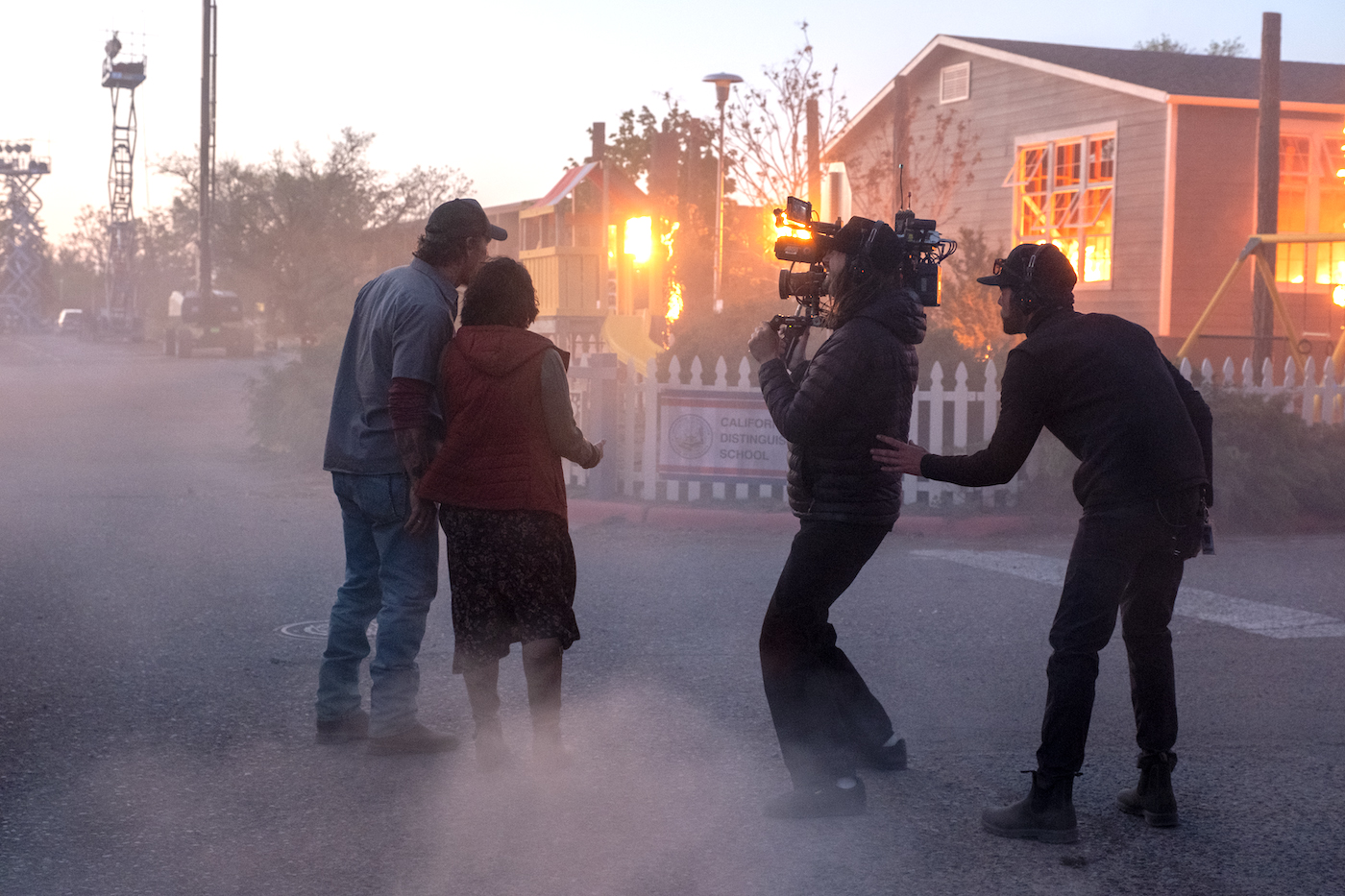
This was Noble’s sixth film for Greengrass. Noble explains, “At this point, I’m used to his style, and my mission is to give [Greengrass] the freedom to shoot as he wishes. I was the third one on this show, and we got a chance to do a lot of prep, including studying an hour of reference footage from the actual event. John Messina, the fire commander [who plays himself in the film], also brought more references in, along with advice for us.”
Finding an appropriate location to shoot the film brought Greengrass back to familiar territory. “He had a great experience in New Mexico on News of the World,” Rokseth says. “The big problem was there were no [forested] trees, and of course, we needed a lot of trees, so landscapes got built at Garson Studios in Santa Fe.”
Special Effects Coordinator Brandon K. McLaughlin notes, “I knew from the start that we were going to work hand in hand with Charlie and his VFX team to make this happen, since it had to be a spectacle beyond what could be safely done just with practical means – especially given we had children involved. I’ve done a lot of work in Santa Fe and Albuquerque, so there are good relationships established with those fire and police departments. I showed them many tests so they could know what to expect. We were surrounded by schools, residences and businesses, so they had every right to demand care on our part. This is part of why I told production up front that we couldn’t do burning embers practically in New Mexico. We don’t have control over the wind, and if a big gust came up, it could blow right into dry brush outside of the shooting area. Instead, I offered to provide practical ember elements, which were used as a reference.
“[Greengrass] told us that he wanted the fire and smoke to be its own character in this film,” McLaughlin continues. “And he was specific about insisting that audience members not sit there and think, ‘This is all visual-effects fire.’ We told Paul that if I could put a small amount of real fire in every scene, then VFX could build off that and extend the real thing.”

With handheld camerawork a given on Greengrass projects, Rokseth assembled what he called a “digital equivalent” to a Super16 package, choosing the ALEXA 35 as his principal means for image acquisition. “I knew Paul liked using nimble, lightweight cameras with long-lens zooms attached,” Rokseth explains. “His documentary work was often done on Super16 film cameras, and he relied heavily on zooms to capture critical moments caught on the fly. We carried the Canon T2.4 8-64-millimeter zooms, as Paul loved having the longer range for dynamics.” Though this meant cropping into the S35 and thus cutting resolution, capturing open-gate ArriRaw would afford Rokseth the option to finish in 4K.
While digital cameras once carried with them considerable limitations in capturing the full range of flame color, that is no longer the case. Rokseth – whose strong preference for selecting a single LUT mirrors his approach to relying on a single filmstock – worked with Company 3 Colorist Stephen Nakamura to develop an appropriate show LUT. “I always tell my clients that by using a camera-neutral LUT that maximizes the camera’s chip, I can later do color correction on the inside,” Nakamura states. “By that, I mean whether you go warm or cool or brighter in blacks, you’re shaping what amounts to being a mold to compress the image shape. When I’m in the finishing stage a year after shooting, the mold formed by that neutral LUT gives me almost total flexibility to accommodate changes while maximizing what the DP shot.” In the DI phase, Nakamura would be able to address image clipping through defocusing of hard edges and luma keys, as well as occasional color embellishments.
After seeing a presentation at the Sphere in Las Vegas, Greengrass initially considered embracing a near-virtual approach to the story’s more pyrotechnic aspects, an idea that led him to use the Volume for some of the action taking place on the bus. Ultimately, that methodology was minimized in favor of his trademark nitty-gritty you-are-there realism, but the LED screen did see a certain amount of action. “The idea of a volume around them was a good one,” said Noble, “one that gave the actors something to look at as well as interactive light, and so we used that for just certain scenes we couldn’t get while driving around outside. We produced a lot of material for the StageCraft screens, but that material was only ever going to be lighting and eyeline reference. We felt that once we’d shot outside with the actors, there was less to pick up, so there were only a few days on stage.”
Rokseth started testing at ILM on the Volume. “We found out which kinds of panels reproduced fire best and determined what we could do to best augment the screens,” he shares. “Dense, strong colors from fire don’t always reproduce well on screens, so it was also a matter of testing fixtures to work in concert with it. We had flame bars close to the vehicle, too. Then we changed how we shot the Volume, going from a full 360 to one where the area behind the camera was all blue. I used Kinoflo Mimiks to put media onto that. I could project real fire or stuff that ILM had produced using Unreal Engine. They emitted the same light, like a poor man’s LED screen.”
More would be needed to sell the illusion of motion. “We had to come up with a gimbaling system for the bus,” recounts McLaughlin. “I felt a traditional six-axis gimbal was going to be excessive, putting the children 10 feet in the air and thus making the loading and offloading a big problem. So I came up with a hydraulic ram on each wheel that could raise and lower each corner of the bus by a foot, though we couldn’t operate it at full stroke because it started to make some of the children sick. Working off the ground did make it much quicker for the crew to film and for Paul to get every shot needed.”
B-Camera Operator James Goldman came onto the project in midstream. “I missed out on the early fire stuff,” he acknowledges, “but did stage work and outside driving work. The bus was in this fantastic gully they built outside. There was road stunt stuff, driving at night. I saw a lot of fire effects, which are contained and therefore aren’t quite as dangerous. Plus, we had complete trust in the team handling that end. Paul puts together a good crew, finding people who work well together.”

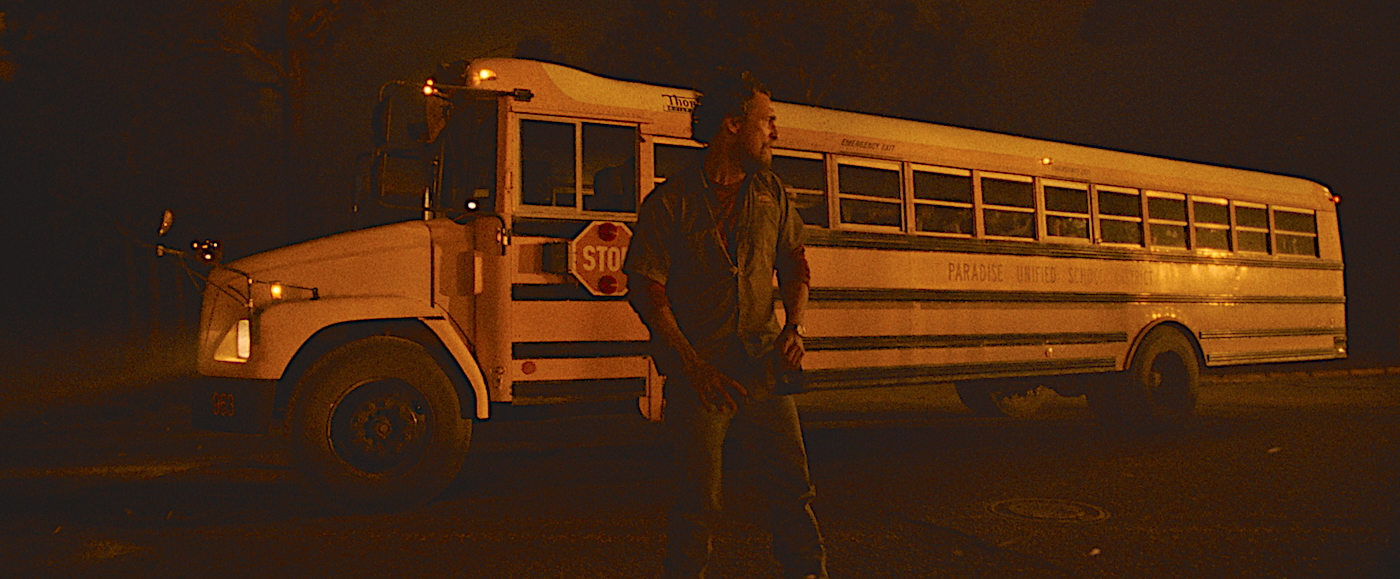
The bulk of the bus scenes was accomplished on the backlot, with McConaughey doing most of the driving. Since the fire blocked out the sun, production needed to come up with a way to keep the light consistent. “You couldn’t do silks over a long area like we needed,” describes Rokseth, “so we ended up shooting most of it at dusk, using the magic-hour vibe since there was no sun, giving us something like that weird, occluded eclipse-look light.” The DP says he sought to balance the more yellowish look of the propane flame with that of the more reddish hues associated with organic materials ablaze. “I augmented a lot of fire with tungsten light, which we used for everything. At some points, we had to have so much light to backlight the smoke to give the idea of the smoke blocking out the sun. We punched in a ton of tungsten light coming from cherry pickers and Condors. That meant our gaffer, Todd Heater, had to dust off these old Skypans, which worked great to give us the needed lighting firepower.”
The magic-hour shoot drew on the combined efforts of the first and second units. “I came in with 2nd Unit Director Jeff Dashnaw and the stunt team Brand X,” 2nd Unit Director of Photography George Billinger states. “Up front, we all discussed ways to embrace this approach to lighting and also studied references from the Paradise fire to get a baseline for our work and fuel ideas we offered Paul. We tried to match his interactive lighting, especially the smoke levels for how they impacted ambiance and diffusion.” The bus interior was lit with small LED’s and tubes to fill in the shadows.
As many as six cameras would roll during the lengthy magic-hour takes. “Sometimes the first unit shot other stuff during the day while we got ready, but then the units would merge for that hour or hour-and-a-half,” Billinger recounts. “Given that we each had our own sections, that was the most efficient way to make our day. A lot of shots with the bus in motion used an F-150 stunt truck that was rigged so we could chase the bus from either the front or the back, usually with me hanging off the truck and my camera supported by a bungee rig with a big hoop. We had Red Komodos for the hard-mounted bus exteriors,” he adds, “along with DJI Osmos capturing 4K RAW in throwaway mode, sometimes just inches off the ground outside.”

Practical effects, unfortunately, sometimes bring practical side effects. Rokseth says the team “tested this fantastic oil-based smoke for exteriors. It had a nice texture, but it was so extreme that we had oil hitting the lens and the windows on the bus. Partway through, we wound up switching to a water-based smoke that vaporized quickly in the heat.”
In addition to smoke and flame, creating the effect of high wind and airborne debris also fell to SFX. “I have done many films needing me to provide that interactive element, but on this film, some of our locations were so remote it became difficult to place fans,” McLaughlin concedes. “So, this became another instance where Charlie came to the rescue. We provided as much wind and debris as we could and gave VFX a handful of element shots, which they were then able to use for the times when we couldn’t provide full coverage.”
DIT Rafel Montoya says that while preproduction essentially created a playbook for the shoot, things would inevitably change on the day. “It was a single-LUT show, but we found ourselves diving into the CDL’s for the low-light stuff,” Montoya explains. “We get darker and darker as the film progresses, contrasting with the blue sky in the opening of the film, but Paul wanted it all to look natural so that it seemed the fire was lighting the action. He and I were in a mobile DIT van, a real beauty that had all the grippage and brains to let me do live grading on as many as four cameras, plus I was riding irises on all of them. Pål, or ‘Wolfie’ as he was called, was on A-camera, and we both had HD headsets, so I could give him notes from Greengrass during each take.”

McLaughlin’s team fashioned all the burnable elements from steel. “One crew built trees, another branches,” he notes. “There were twenty-eight of these four-inch diameter, 16-inch metal pine tree trunks, along with lots of Manzanita bushes that got built, plus fifteen fire mats that could be used as piles of brush or leaves,” he shares. “For some buildings, we built partial structures from two-by-four pieces of steel welded together, then cut slits in them and plumbed them from beneath with propane.” In all, SFX plumbed nearly 14 miles of three-quarters-inch and half-inch black pipe to feed 60 burning set pieces. Vaporizers took liquid propane, with a pair of two-inch lines feeding manifolds that controlled ten separate valves. “I had somebody on each manifold, plus a crew for fire suppression as an additional safety,” McLaughlin adds. “Then there were shots when I’d have the guy turn these flames up a bit more, because with the bus passing at 25 to 30 miles per hour, there was no real danger; you’d get this great fire interaction of air displacement as it came roaring past.”
The toughest sequence for SFX involved setting real fires in the forest. “There were days when I’d have to make the call to pull the plug,” McLaughlin admits. “And that’s fine, because somebody has to be able to be responsible enough to say this is not happening. I certainly didn’t want to go down in history as the guy who burned down Santa Fe! And I have to say that Greg, Apple Safety, and 1st AD Cliff Lanning, whom I all knew from working on Deepwater Horizon, showed diligence and focus whenever we had to set big fires.”
VFX embellishments were extensive. “The backlot didn’t have trees, so anything seen out the window had to be CG,” states Noble. “So, we just kept the immediate road around the bus and replaced what was above, plus added smoke and other elements coming through the frame. The compositing effort was tremendous; it was something I would have run screaming from just a few years back, but it just got handled without too much loud squeaking.”

Greengrass devised a notion for a “fire POV” that became a recurring (and very effective) element in the film, portraying the fire as a voracious monster sweeping through the land. “It was a very cinematic tool to create tension,” says Rokseth, “so we used drone shots, and then Charlie did VFX work on them.” An aerial shoot over the real town of Paradise facilitated this effort. The fire POV was first previsualized. “We’d start with a virtual camera,” Noble explains, then use a real camera to give it some weight, and combine those two. The human camera had the bendy twisty stuff, and that was then fed into the CG camera, like it was an ember blowing and twisting.” The second unit also used drones close to the ground to follow the fire.
The DI was an instrumental step for exerting further control over the look of the film in ways that gave greater emphasis to the personal dramas playing out onscreen. “Since this movie is largely handheld and at night, part of the color-correction process was my trying not to make it all look like monochromatic flame,” Nakamura relates. “The whole image can tend to go a little sepia, saturated orange-red. My idea was to craft images, especially in the darker portions where the faces on the bus lie, so we could create contrast by remaining very color-neutral in closer views inside there, since darkness predominates over flame and color. This is a way of focusing on the drama of the moment, revealing the despair on their faces in context rather than making it about spectacle. I discussed with Paul and Pål and the whole creative staff how this could help create tension and then later help display relief when they make it through and are back out into the daylight.”
Rokseth remains enthused and energized about working in the Greengrass style. “His approach is really about panning over and hoping to get something unexpected in the moment,” he concludes. “It’s about trusting your instincts, even while knowing sometimes you’re not going to get it, much like documentary filmmaking. I look for a certain confidence in how the camera is moved, and I keep that in mind when interviewing potential operators. Some always want it to be smooth, but that’s no good when you need it to look sloppy or reactive. On one level, it’s scary to give up control of traditional work. But Paul is just such a good navigator about what works and what doesn’t. Honestly, you have to forget about perfection and – quite literally – throw yourself under the bus.”

The Lost Bus – Local 600 Camera Team
Director of Photography – Pål Ulvik Rokseth, FNF
A-Camera Operator/2nd Unit Director of Photography – George Billinger
A-Camera 1st AC – Chad Rivetti
A-Camera 2nd AC – Royce Leii Carreon
B-Camera Operator – James Goldman
B-Camera 1st AC – Kingslea Bueltel
B-Camera 2nd AC – Janis Schelenz
C-Camera Operator – Kevin Emmons
C-Camera 1st AC’s – Darin Necessary, Jason “Blue” Seigel
C-Camera 2nd AC – Daniel Lacy
DIT – Rafel Montoya
Digital Loader – Nathan Mielke
Digital Utility – Elleott Herrera
Unit Stills Photographer – Melinda Sue Gordon
Unit Publicist – Jacey Taub