W.
DP Phedon Papamichael, ASC
By Kevin H. Martin

NIGHTS IN RODANTHE
DP Affonso Beato, ASC
By Bob Fisher

LIVING PROOF
DP James Chressanthis, ASC
By Bob Fisher

CALIFORNICATION
DP Mike Weaver
By Pauline Rogers



PRESIDENTS LETTER
Steven Poster, ASC

CREW VIEW
Andy Fisher
By Pauline Rogers

PARTNERS ON THE SET
Maryley and Me
By Pauline Rogers

GEAR GUIDE
Commercial Gear
By Pauline Rogers


SLIPKNOT MUSIC VIDEO
DP Jaron Presant
By Andrew Takeuchi

ESPN NASCAR SPOTS

SPOTLIGHT: MOTION CONTROL CAMERAS


4K WORKFLOW FOR COMMERCIALS
By Jon Silberg
 

A mild flirtation or lasting connection?

By Jon Silberg


Although the 4K DI is still the exception rather than the rule in the feature film world, the concept of working at such high resolution, even on the occasional television commercial, is no longer out of the realm of possibility. In fact, there are some serious qualitative advantages in post production for projects geared to a High Definition, or even standard definition, finish and so post houses are gearing up with color grading tools such as FilmLight's Baselight and daVinci's Resolve to work on images either captured digitally in 4K or shot in 35mm and scanned to 4K.

For FotoKem's Andrew Oran, director sales for special formats, the idea of "over-sampling" (digitally or photo-chemically) makes perfect sense for someone looking to maximize the visual quality of any project, whether it be the giant-screen shows FotoKem has been digitizing at up to 11K resolution, 2K workflow for HD finish or HD processing for SD delivery. "A 4K workflow could definitely improve images that end up being seen as a lower-res HD broadcast," he says. "We review standard resolution reference scans on most of the images that we oversample, and can always see improvements in the down-coverted frames when cross-referenced to their standard resolution counterparts.” You might not think it matters how much visual information is packed into a frame if it’s ultimately destined to be seen on a much lower-resolution display, but for Oran the pictures tell a different story. “It’s amazing just how good HD, or even SD looks if the material originated in 65mm and is scanned at 8K, as was the case for the recent HD master we produced on the 70mm film Baraka. It may not be practical for most people to consider shooting commercials this way, but the qualitative advantages are real.”
FotoKem, he points out, has the infrastructure to post commercials in 4K, but he notes that the cost and time involved at this point in the technology is still significant. "Having that additional information," he says, "can offer increased quality and it can be helpful for some visual effects work even if producers and agencies aren't finding the difference worth the increased investment at this time."

Tim Masick, senior colorist at Company 3, New York has seen a couple of spots come through the facility in 4K. In the case of a campaign for Chase Manhattan Bank the scanning of the 35mm film in 4K offered enough resolution to pull out from a tight shot of a credit card out to a wide shot of the actor holding it. This was all done in post rather than using a camera move. Though the end of the move was a small piece of the original frame, the film benefited so much from the 4K scan that even at its tightest, the resolution of the shot was still effectively an over sampling for the HD format in which the spot would air. Masick calls his introduction to a 4K workflow (Company 3 used the Resolve with 2K proxies and then rendered the corrections out in 4K) “eye opening.” The greater amount of information made for a greater ability to cleanly augment the image. "It was amazing," he recalls. "At first I didn't think there would be much of a difference between 2K and 4K so I said, 'Let's just take a look and see what we can do in 4K and it was shocking. It was like maybe ten years ago when I was used to working in SD and I first saw what 2K could look like."

That being said, Masick is also quick to add that a 4K workflow is not something he expects to see in large quantities, except when the cost is justified by something like the specific effect called for in the Chase spot. "It costs more to scan," he says, "and then we're talking about 4K DPX files at about 58 megabytes a frame so it's a significant addition of cost and rendering time.” Masick calls it a “great option” to be able to offer 4K color correction to any potential client, but he remains skeptical the format will be used throughout the commercial industry, save for those “special circumstances.”
Company 3 principal Stefan Sonnenfeld concurs. "There are clients who want to finish in standard def," he says, "so realistically we do commercial work at High Def or maybe 2K, but 4K is not a prevalent way of working. But we use ARRI scanners and daVinci's Resolve and if a client wants it, we have the infrastructure to provide it."
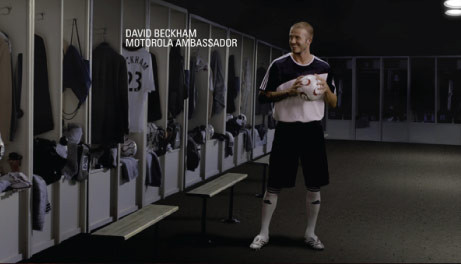
Cinematographer Byron Warner recently used the Dalsa Origin in its 4K raw format to shoot soccer superstar David Beckham for a multi-media campaign for Motorola's RAZR phones. In this case the production and post company, Culver City-based IE Effects, went with the Dalsa Origin for a spot that would air in a number of European countries in standard definition formats and on relatively tiny 320 x 240-pixel displays on RAZR phones. So, then, why even use the large and expensive 4K system?
“It had a lot to do with time, Warner explains. "We had four sets, four lighting changes, four wardrobe changes to do and Beckham was only going to be available for 45 minutes! The idea was that we needed to be able to shoot him from the knees up and be able to pop into a medium shot or a close-up or add different kinds of 'camera moves' in post. We'd have one camera set-up per set, he'd read off a prompter and whatever we got had to become our 'coverage.'

By starting out with the 4K image, David Kenneth, executive producer at IE Effects and the director of the spots, had the option of changing the focal perspective of the superstar’s movements within a stationary frame. "We could start on a medium shot and push all the way into his ear," Warner says. "Since we started with a 4K image and we were finishing for standard def, we could push in 600 to 1000% without degrading the image at all."

The raw 4K images, which were converted at IE to TIFF files, were then also repurposed in a way that hadn't originally been planned. Kenneth describes the added usage as a “feather in Dalsa’s cap,” given that individual frames were blown up and used as part of an image placed on billboards all over the world. “It's not like the frame was the whole billboard,” he relates, “but it was still blown up very big and it looked great."
Kenneth, who oversaw the posting of the spot, including the color correction (done at 2K using the Iradas SpeedGrade system) notes that while the 4K cinematography and subsequent amount of data required an investment up front, the payoff came in the form of the final spots. "We couldn't have gotten all the material we got in 45 minutes any other way," he says. "We could have tried it with multiple cameras but that would have been more complicated to set up and it would have caused problems with eye lines and any number of other issues."

Warner adds that he could have achieved a similar result by shooting 35mm and scanning that at 4K, but he notes that even a few magazine changes can take up a significant percentage of a 45-minute shoot. Furthermore, the cost of scanning film at 4K remains high enough that the Dalsa Origin system was a cost-effective approach.
If history is any indicator, there will be a time in the not too distant future when the costs associated with 4K will come down and then producers may well flock to images that are more robust as a result of over sampling. When the questions being asked become purely aesthetic, where will the commercial industry go?
Masick, for one, says he was startled by the amount of visual information in the 4K frame, but then adds that some of his clients would still not find that an instant plus even if the cost issues associated with a 4K workflow were minimal.
"We don't do many spots in the world of beauty and skin products at HD resolution,” Masick smiles. “The plain truth is that you see too much, and a 4K image would push the clean-up process that much further down the road."