W.
DP Phedon Papamichael, ASC
By Kevin H. Martin

NIGHTS IN RODANTHE
DP Affonso Beato, ASC
By Bob Fisher

LIVING PROOF
DP James Chressanthis, ASC
By Bob Fisher

CALIFORNICATION
DP Mike Weaver
By Pauline Rogers



PRESIDENTS LETTER
Steven Poster, ASC

CREW VIEW
Andy Fisher
By Pauline Rogers

PARTNERS ON THE SET
Maryley and Me
By Pauline Rogers

GEAR GUIDE
Commercial Gear
By Pauline Rogers


SLIPKNOT MUSIC VIDEO
DP Jaron Presant
By Andrew Takeuchi

ESPN NASCAR SPOTS

SPOTLIGHT: MOTION CONTROL CAMERAS


4K WORKFLOW FOR COMMERCIALS
By Jon Silberg
 

DP Jaron Presant Leaps into the Inferno for Slipknot’s (hell)atious new video, Psychosocial

By Andrew Takeuchi


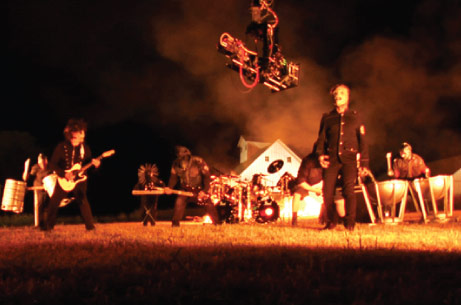
No one can accuse a music video DP of playing it safe. But sometimes even the most adventurous shooters find themselves on sets that are way beyond the pale. Like an empty farm field somewhere in the middle of Iowa in the pitch-black dead of night, with nine angry, screaming men in horrific face-masks flailing around a ring of fire.

“The first phone call I got,” cinematographer Jaron Presant explains, chuckling at the memory of how his work on Psychosocial, which made its early August debut on MTV as the music channel’s #1 video, came about, “was that the whole video would be 1000 frames per second or hand-cranked 35mm. That was literally the call.”

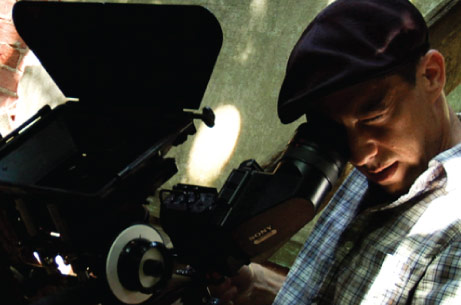
Luckily the voice on the other end belonged to Paul “P.R.” Brown, a director Presant has collaborated with on more than one hundred music videos. The pair hooked up about 6 years ago, early in Brown’s music video career; Presant started his own career when he was 16, working as an assistant for cinematographer Tom Richmond, and then continuing to shoot videos and AC while also attending USC’s School of Cinema. Presant calls his partnership with P.R. Brown, “a wonderful creative marriage, which is what I love about the business, that you can create these long-standing relationships.” He says he and Brown have forged a verbal shorthand when discussing ideas. “It’s great on the set because I know what he likes and he knows what I like,” Presant says. “Our tastes are aligned so I feel a little bit more free to suggest or do different things on the fly, because I’ll know whether or not it’ll mix into where his head’s going.”

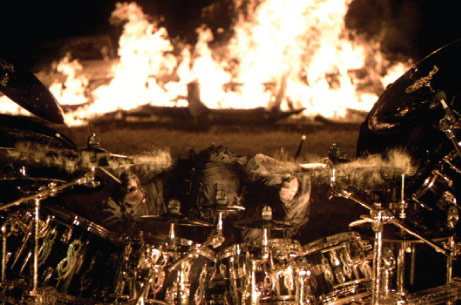
And that’s a good thing, harking back to that burning Iowa farm and those nine pissed-off musicians. Presant says that after his initial phone call from Brown, the basics of the shoot were quickly settled on; a night performance by Slipknot, whose nine members all live in Iowa, involving fire and large masks. Slipknot, in case your 15-year old has not informed you, is one of the music industry’s most celebrated hardcore metal bands, known almost as much for their extreme look as for their belligerent and chaotic performance style. All nine members wear matching dark jumpsuits and demonic fright masks that put Freddy Kruger to


shame on his very best day. In addition to their real names, band members are often referred to by the numbers zero through eight.

Fortunately for Presant, he’d already worked with Slipknot a number of years back doing a European tour documentary. “They’re not a band that where you just show up to shoot without realizing what you are getting into,” he reflects. “The video had to embody their performance on an almost visceral level. To achieve that, we had to go into locations that were probably less than healthy and use real fires, not something computer generated. The results had to have a look and feel that completely mirrored the band’s intensity.”

To enhance Slipknot’s chaotic energy, Brown wanted to capture much of the footage at terrifically high frame rates, ranging from 300 to 1000 fps. This process would allow for selective speed ramping, from real-time sync performance to extreme slow motion. The logical rig for the high-speed footage was Vision Research’s Phantom HD camera, which offers a 2048 x 2048 pixel CMOS sensor, with a PL mount that can be fitted to capture HD or 2K images using 35mm motion picture lenses for true 35mm depth of field and field of view. “One of the biggest pluses to the Phantom HD system,” adds Presant, “is that you can see instantly how slow the shot will be on screen.”

The ability to review footage and gauge the amount of action slow down, is according to Presant, key to shooting humans and roaring flames, both moving in rapid, often unpredictable motion. “With the exception of table top cinematographers, I don’t know many people consistently shooting at super high frame rates,” says Presant, “so knowing the difference between 300 and 500 frames a second in relation to fire is a very specific knowledge.”

Case in point was a set-up featuring large paper mache heads, about two feet across that were placed on a stake and set on fire. “We shot those at 300 fps and they looked the same as a giant wall of fire that was 32’ across and 26’ high,” the DP continues. “In order to slow down the wall to a comparable on screen speed as the paper mache heads, we had to shoot at 1000 fps. The ability


to see playback at speed immediately, and accurately, helped to make those frame rate judgment calls.” Presant also got a crash-course in flame dynamics. “A very interesting thing I learned,” adds Presant, “is that the size of the fire affects the speed of the fire, which impacts how fast you roll. What we found is that with smaller fires, the flame moves slower, so you can roll at a slower frame rate because you’re just trying to slow down an already slow moving flame.”

Jumping to the other end of the technological spectrum, Presant employed an Arri III, specially converted by Panavision to operate as a hand-cranked camera. He chose a set of old Baltar lenses that would accentuate the contrast between the look of the film and the HD footage. Keeping with the old/new school theme, Presant chose the new Kodak VISION3 500T 5219 stock. He describes it as having “amazing latitude” and super-fine grain, possibly even comparable to Kodak’s low-speed, daylight balanced 5201.

Unlike features, or even many commercials, where the story drives the train, music video is short-form filmmaking in its purist form: image-making is the engine and the stranger or more daring the better. Brown’s use of hand-cranked footage, which mirrored Slipknot’s fragmented style, allowed for erratic motion fluctuation, although Presant points out that changing crank speed on the camera is not as easy as it might seem.

“I always used to be amazed that movies could’ve been made for so long with hand-cranked cameras,” he marvels, “and look, relatively speaking, so consistent in terms of exposure and speed. You always hear stories about how the operators would sing songs to themselves to get the pacing down. But what I’ve learned now that I’ve shot a lot of jobs with hand crank – is that you actually have to be erratic in order to make hand crank look crazy. To get an unpredictable fluctuation of movement, you have to go from 24 to 6 to 48 to 0 to 24, meaning you adjust the frame rate a lot. It seems totally crazy when you’re running the camera because your hand is going so erratically.”

Presant said that he and Brown cherished the ability to create “happy accidents” with in-camera layering, by cranking the footage forwards and backwards to double and sometimes triple-expose the film. Varying crank speed and direction with the beat of the music produces layering and pulsing that’s timed with the performance. “You get naturally occurring fluctuations; though you could create them in post, arguably with more precision and more control,” explains Presant. “But it’s the variability of it all that makes for these perfect moments. Creating them in post would be complicated and time consuming, with multiple layers of varying speeds and directions, all working to the beat of the music and yet all having to work as a cohesive whole.”

Psychosocial is a scary, and surprising song – abruptly shifting from intense white noise to a beautiful, lilting melody. Like the band’s performance, shooting in two formats, at night, at a distant location in Iowa, presented its own surprises. Foremost was finding a talented crew and the proper equipment to do the job. Budgetary limitations meant Presant could only bring along his 1st AC, Peter Lee, and that most of the camera and lighting equipment had to be procured locally. Presant was quick to tap his friend and mentor Steven Poster ASC, to help secure a strong local crew. “Every time I go to a new city, I call Steven (Poster) and, invariably, he knows someone from that town. If he doesn’t, than he knows somebody who knows somebody, so I’m always getting great recommendations,” said Presant. This system of referrals brought him Minneapolis-based gaffer Dave Palm, who Presant called “fantastic.”

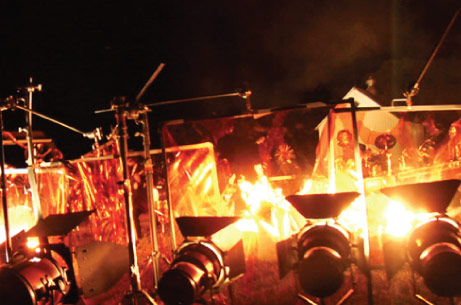
In terms of lighting, shooting at 1000 fps presented its own challenge. The band and the giant masks had to be lit at a high foot candle level for exposure, and Presant knew it would be difficult to find any large units in the area. “In Iowa there are no 20Ks and the number of 10Ks that even exist I can count on one hand,” he relates. “The other issue you have at 1000 frames per second is that small filament lights show decay from the AC cycle – so you’ll get flicker out of tungsten. We had to go with 2K lights or higher.”

Presant says his team ended up using an array of 2K Mighty Moles through full CTO, with ½ CTO in strips and a little bit twisted for the firelight. “The breeze caught on the gel and would move it a little bit,” notes Presant. “That was Dave’s idea. He said he does it all the time for his fire effects and it worked beautifully. We put 2Ks in sets of three onto Magic Gadgets dimmers, so they would they have a random pulse as well.”

The lighting scheme employed six 2K Mighty Moles at full spot on each of the nine band members, generating plenty of illumination. Since the hand-crank camera would be shooting simultaneously, Presant had to layer a stack of ND’s on that camera and, due to the variable frame rate, carefully estimate his base exposure. To complicate things, the local Technocrane crew was stymied by the cabling set up of the Phantom HD camera, which created a delay early in the shoot. Presant says he missed a couple of dusk shots. But “in a true happy accident,” they shot some of them on the hand-crank camera and the results were better than they would have been at high speed.


Presant is careful to note that the sole purpose of music videos is making imagery that’s cut to music. “There is a treatment that acts as a spine,” he says. “But the genre allows for a different and more free form creativity. If an image is beautiful, you can use it!” He says he often tries to set an environment that gives him enough freedom to grab beautiful shots. “With budgets getting cut lower and lower, the ability to get five or ten great shots out of one setup instead of one shot has become a necessity,” he adds. “My approach is often to set the scene where, from one setup, I can get a number of shots and see what develops from that angle. Inevitably there are shots we didn't imagine going in. But when you work with a director consistently, as I have with Paul, your aesthetics align and the amount of creative freedom you have increases. The end result is more opportunities for images that you may not have thought of going into the project, but that come up as you are shooting the project. It just makes things so much easier knowing that Paul is always looking for those stunning images as well.”