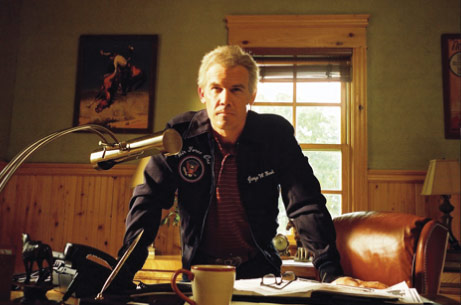
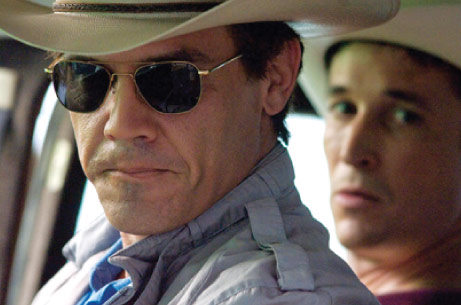
of filtrations that helped capture Bush in age-appropriate light. Mitchell B and C diffusion were used for wide and tight views of W. as a young man. “It isn’t as popular these days,” first AC Joe Sanchez allows, “but in the past it was used to make ladies look better, and it helped Josh play younger.” For Bush’s ‘middle years’ Papamichael went with regular Tiffen Pro-Mist, ranging from one-eighth to one-quarter, which let things bloom a little, and helped the idea that the character was becoming spiritually awakened. After W. becomes president, the DP opted for one-eighth of Black Pro-Mist for his lens filtration.
Another method used to convey Dubyah’s interior tensions involved varying the shutter. “The early years look a bit starker,” Papamichael reports, “so we went with 90-degree and 120-degree shutters to convey his restlessness and tension, and help emphasize the conflict with his dad [James Cromwell.] We left the shutter effects out of the middle period, but then reemployed them when he is a president in crisis. The film becomes more monochromatic, and I let walls fall off into darkness. We also played some wider angles in the Situation Room, where we didn’t want to spend time covering everybody in singles. The room is like the War Room from Dr. Strangelove, so we built a light panel over the conference table to evoke the [Ken Adam-designed] overhead light ring in that film. “
A Maverick In The House
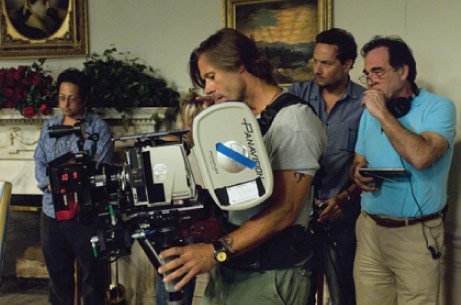
Allowing for the short schedule, Stone opted for many shots to be done in just a few takes, although each had its own quality. “A-camera and SteadiCam operator Gary L. Camp would be allowed a more traditional way of framing that would usually be take one,” says Papamichael. “Oliver asked me to use Danny Hiele to operate B-camera, and Danny’s take would have a different style. He’s a DP with a music video history. Oliver likes to let accidents play, so even if Danny did some aggressive stuff, like going right in to minimum focus or a bit beyond, Oliver kept telling me to let him go. He’d say, ‘If we can only use twenty percent of the shot, that’s fine, it’s another option.’ It illustrates how open Oliver is, and the challenge it presents for camera people, myself included. I always want to meet and work with directors who will take me places I wouldn’t go on my own. “
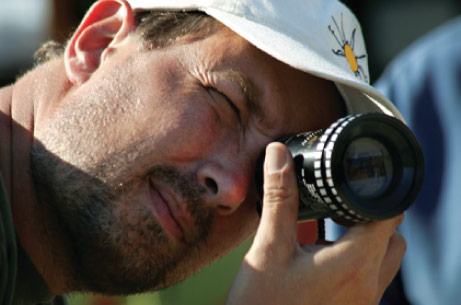
That sentiment is an apt description for some of W.’s extreme shallow-focus shots, where only one area is in sharp focus to convey a distorted perspective. The visual was achieved with the Lensbabies system, pioneered for still camera use and converted to film via Panavision-made adapters. Papamichael characterizes Lensbabies as a technical variant of the Arri lens used by Janusz Kaminski on The Diving Bell and the Butterfly, which allowed for manipulation of the focal plane. “But while this is like a swing and tilt,” he notes, “you don’t rotate it into position. You can pull to one side to get a particular plane into focus. The operator is the only one who can see what is happening focus-wise.” The technique was used for a number of subjective shots as well as close-ups. It was applied for W.’s POV when he was drunk, and later when he is trying to listen to preachers, suggesting his drifting perception and limited awareness. To emphasize moments when Bush is overwhelmed or confused, close-ups were used, focusing only on his mouth or one eye.
A Wild, Wild Ride
Even with extensive pre-visualization by visual effects supervisor John Scheele and Stone’s own pre-planning, W. was mainly a process of discovery, even beyond the use of Danny Hiele’s experimental framing. Papamichael says that Stone is the first to say,
|